Cohort 13 mission statement
With the eye of the tiger, we lead with focus, determination, and fearless strength. We are boldly pursuing progress and embracing every challenge with clarity and courage. We don’t follow standards; we set them. Grounded in innovation and driven by purpose, we redefine what leadership in educational technology looks like. As Cohort 13, we embody the transformative power of a number often misunderstood. We are disruptive, resilient, and unapologetically trailblazing. We are here to shape the future of learning and equity through technology.
Motto
Together We R.O.A.R.: Research. Lead. Transform.
The statement and motto were written collectively by the twelve members of Cohort 13 and are published on the cohort’s own site, which also documents Summer Institute I day by day.
Your contribution to the Cohort 13 Showcase demonstrates strong engagement and creativity. I appreciate the specific work you described. This shows both initiative and collaboration in helping your team succeed. I'm incredibly impressed with your self-reflection and growth about the group dynamics situation. Overall, your submission is impressive. Keep building on your strengths while actively applying what you've learned from your reflections. — Instructor attempt feedback
Submitted 7/26/25 · Receipt AB7482B4B6C243B9BEDC9D761DF17501
Professional Growth Plan
EDTC 801 · Summer Institute I · New Jersey City University
The Professional Growth Plan is the document this entire portfolio grows out of. It sets a leadership vision built on the leadership theories discussed by Northouse, names the strengths I intend to build on and the growth areas I intend to confront honestly, and converts both into SMART goals with dates attached.
The plan is presented in full on the home page of this portfolio, where each goal is set beside the evidence that it is being met.
Digital Portfolio — first iteration
EDTC 801 · Summer Institute I · Google Sites
The original digital portfolio was assembled during Summer Institute I as a Google Sites build. It established the structure I still use — growth profile first, then the three program domains, then leadership and service — and it remains available as evidence of where the work started.
This site is the second iteration of that same portfolio, rebuilt so that every artifact can be opened and read in place rather than downloaded.
Leapfrogging the Gap: Transforming Girls’ Education in Africa
EDTC 802 · Principles of Educational Technology Leadership · Group project
About this project
This proposal was researched and written collaboratively by a three-person team — Aimie McKenzie-Smith, Elizabeth Elie and Kareen Ogunmakinwa — who together explored the Brookings Global Catalog of Educational Innovations to surface the growing movement of organizations breaking barriers for girls across sub-Saharan Africa.
The scale of the challenge
Global education faces a crisis, and the most marginalized children are falling furthest behind. At the current pace it would take a century for the most marginalized children to reach the learning levels of today’s wealthiest students, and by 2030 as many as 800 million young people may lack the basic skills needed for the modern workforce and civic participation. The underlying issue is not access to school alone but access to quality learning — critical thinking, communication, and creativity.
What leapfrogging means
Leapfrogging means skipping outdated systems and jumping straight to modern, effective approaches, in the same way that many countries skipped landline infrastructure and moved directly to mobile phones. Applied to education, it means moving past rote memorization and going directly to adaptive twenty-first-century skills, using technology to personalize learning and empowering communities to help deliver education. Leapfrogging is not about catching up; it is about creating a faster, smarter path to prepare all students for the future.
How we chose the topic
The topic emerged from researching the sub-Saharan African section of the Brookings catalog. We found that girls across the region face multiple, compounding barriers to gaining a quality education, and the struggle of girls in this region compelled us to investigate both the barriers and the innovations built to answer them.
Barriers and innovations
The barriers include forced marriage, poverty, health struggles, and systemic gender inequality. Against these, the Global Catalog of Education Innovations highlights a range of impactful initiatives across the region that directly empower girls to overcome these struggles and succeed.
Case study — REAP 2
The Rwandan Girls’ Education and Advancement Programme 2 is a targeted education-and-transition initiative aimed at improving school results and securing better future prospects for underprivileged, marginalized girls living in rural areas, especially within the Nyaruguru District. It is funded under the Girls’ Education Challenge, a UK-aid funded challenge fund managed by the Department for International Development.
REAP 2 achieved significant success in improving girls’ education, increasing overall school attendance and notably enhancing learning outcomes. It created safer, more supportive school environments, strengthened community involvement, and promoted girls’ personal health and confidence. Its support systems trained teachers in modern, gender-sensitive methods, provided after-school study groups, improved critical menstrual hygiene facilities, and engaged parents and local communities to champion girls’ education.
Key themes across the cases
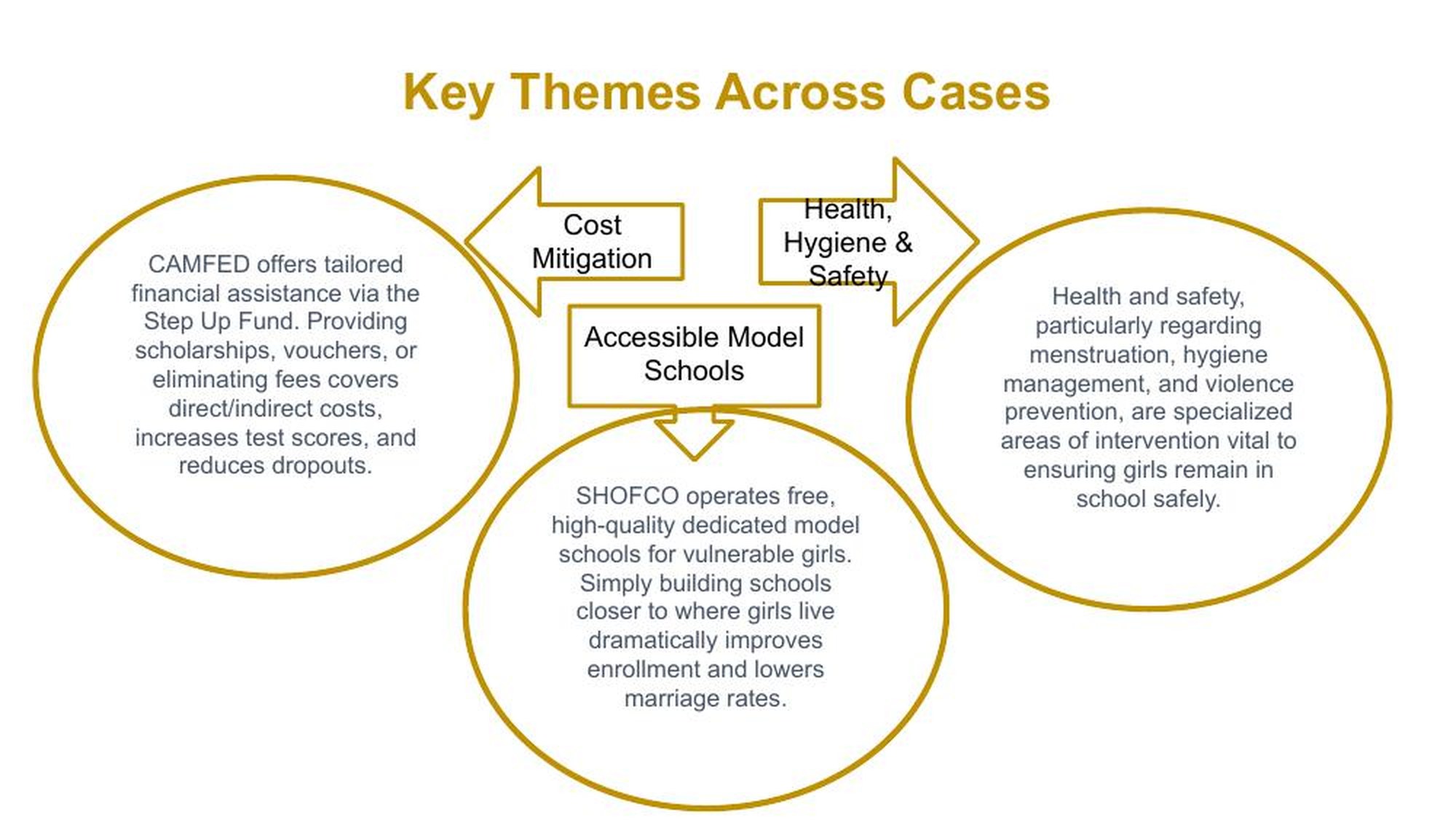
Cost mitigation. CAMFED offers tailored financial assistance through the Step Up Fund. Providing scholarships and vouchers or eliminating fees covers direct and indirect costs, increases test scores, and reduces dropouts.
Accessible model schools. SHOFCO operates free, high-quality dedicated model schools for vulnerable girls. Simply building schools closer to where girls live dramatically improves enrollment and lowers marriage rates.
Health, hygiene, and safety. Health and safety, particularly regarding menstruation, hygiene management, and violence prevention, are specialized areas of intervention vital to ensuring girls remain in school safely.
Conclusion
Improving girls’ education is not just about access. It is about creating a holistic, supportive, and inclusive system where every girl has the tools, support, and opportunity to thrive.
References
Gates Foundation. (2025). A teacher interacts with students during a phonics lesson at the Nal’uxolo Primary School in Cape Town, South Africa [Photograph]. Global education program. https://www.gatesfoundation.org/our-work/programs/global-growth-and-opportunity/global-education-program
Winthrop, R., Barton, A., & McGivney, E. (2018). Leapfrogging inequality: Remaking education to help young people thrive. Brookings Institution Press. https://www.brookings.edu/book/leapfrogging-inequality-2/
Themes of Leadership: Empathy, Authenticity, Ownership, and Courage
EDTC 802 · Principles of Educational Technology Leadership · Dr. Christopher Shamburg · August 2025
Introduction
Leadership in the twenty-first century is increasingly measured by the quality of a leader’s relationships rather than by the authority of their position. This essay examines that shift through four leaders who arrive at it from very different directions. Jacinda Ardern demonstrates leadership grounded in empathy and public authenticity during national crisis. Oprah Winfrey demonstrates transformational leadership exercised through platform, storytelling and the deliberate use of her own history. Jocko Willink, a former United States Navy SEAL officer, argues from a military background for accountability, discipline and humility. Brené Brown, a social work researcher, makes the empirical case that vulnerability, courage and trust are the foundations of effective leadership rather than obstacles to it.
Taken together these four suggest that empathy and accountability are not competing leadership styles but complementary ones.
Empathy
During the Christchurch mosque shootings and the COVID-19 pandemic, Ardern consistently connected with the feelings of the people she served, leading with compassion rather than command. Addressing Parliament after the attacks she said of the Muslim community, “They were New Zealanders. They are us” (Ardern, 2019), and she wore a headscarf visiting victims’ families. Her conduct demonstrated that empathy is not merely a gentle skill but a force that supports healing and builds trust. Empathetic leadership does not weaken authority; it strengthens it by aligning leadership with human experience (Goleman, 2006).
Authenticity
Ardern was not afraid to show her human side publicly, and citizens trusted her not because she projected perfection but because she was real. Winfrey built her leadership reputation on the same foundation, telling her Golden Globes audience that “speaking your truth is the most powerful tool we all have” (Winfrey, 2018). Authenticity does not mean a lack of professionalism; it means aligning action with values and remaining consistent between words and behavior.
Transformational vision
Through her show, the OWN Network and her philanthropy, Winfrey built an enterprise focused on personal growth and social change rather than entertainment alone. A transformational leader elevates those around them and is not satisfied with maintaining conditions as they are. To channel one’s own inner Jacindas is to lead with the heart while still respecting the mind — and to understand that durable leadership is built not on fear but on earned trust.
Extreme ownership
Willink’s TEDx talk builds on accountability, discipline and humility. Leaders must fully accept responsibility for team performance; acknowledging their own mistakes builds trust and creates a culture of shared responsibility (TEDx Talks, 2017). His formulation that discipline equals freedom captures how self-control produces better planning and ultimately greater latitude (Willink & Babin, 2017), while humility keeps leaders open to feedback rather than governed by ego.
Vulnerability and trust
Brown argues that vulnerability is not weakness but the core of genuine leadership, since it means remaining open to mistakes and feedback (Brown, 2012), and that courage means holding difficult but necessary conversations (Brown, 2018). Empathy allows leaders to support others without judgment (Brown, 2010), and trust develops through small everyday moments, explained through her BRAVING framework.
Conclusion
The four appear to represent different traditions, but what they share matters more than what separates them. Each locates the source of a leader’s authority in something other than position: in the willingness to be genuinely present with people, to take responsibility rather than assign it, and to be honest about limitation.
Finland’s School Year Through Arnove’s Scientific, Pragmatic, and Global Dimensions
EDTC 804 · Global Issues in Educational Technology Leadership · Dr. Christopher Shamburg · September 2025
What the dimensions are
Timothy D. Walker’s account of how Finnish schools begin the academic year describes classrooms that open with belonging, social-emotional learning, and gradual re-entry rather than immediate academic content (Walker, 2022). This paper examines that practice using the three dimensions Robert Arnove identifies in the field of comparative education: the scientific or theoretical, the pragmatic or ameliorative, and the global or international (Arnove, 2007).
These dimensions are not criteria a school system passes or fails, and they are not qualities that make a reform successful. They are the purposes for which comparative study is undertaken — to build theory, to improve practice, and to promote international understanding — and in practice they function as three lenses through which any approach can be examined. Because they are lenses rather than standards, they can reveal that a practice is thoughtful and transferable, and equally that it is context-bound or harmful when lifted out of the setting that produced it.
The scientific dimension
The scientific or theoretical dimension concerns comparison as a method: the construction of theory, in which comparison across cases establishes what relationships hold between education and society and under what conditions. Applied to Finland, this lens asks what claim the practice is actually testing — that students who feel emotionally secure and socially connected engage more effectively with academic work, a proposition supported by evidence beyond Finland (OECD, 2019).
The lens also imposes discipline. Finland differs from many systems in teacher preparation, funding equity, and child poverty, so attributing national outcomes to the opening weeks of the school year would confuse correlation with cause. Used carefully, this dimension does not confirm that the practice works; it clarifies what would have to be shown for that claim to hold.
The pragmatic dimension
The pragmatic or ameliorative dimension concerns improvement, and operates in two directions: examining practices elsewhere that might be adapted, and using that examination to reflect critically on assumptions in one’s own system. Finland’s opening practices — team-building, structured reflection, discussion sessions, and protected teacher autonomy over pacing — are modest and portable.
The reflective half is more demanding: the account should prompt a reader to ask why the opposite assumption, that instructional time is lost when the first days are not academic, is treated as self-evident elsewhere. This dimension also carries the clearest warning, since policy borrowing that extracts a practice from the conditions sustaining it produces the appearance of reform without its substance.
The global dimension
The global or international dimension situates education within international forces and treats cross-national understanding as a purpose in its own right. Finland is legible through this lens twice over: the competencies its opening weeks develop are those most often named as necessary for an interdependent world, and Finland’s status as a reference point in global discourse is itself an example of how transnational measurement shapes which systems become models — an observation that is not entirely favorable, since rankings direct attention toward what they happen to measure.
Conclusion
Read through the three dimensions, Finland’s approach looks different under each lens. Taken together they do not deliver a verdict on Finland; they demonstrate what comparative analysis is for — not ranking systems, but understanding what a practice rests on, what it might teach, and what would be lost if it were moved.
Analyzing the Pearson Initiative Through Three Educational Paradigms
EDTC 804 · Global Issues in Educational Technology Leadership · Dr. Christopher Shamburg · September 2025
Introduction
The Pearson Initiative, as described by Kamenetz (2016), is a substantial convergence between economic interests and education policy. The program seeks to standardize and enhance worldwide education systems by working with governments in partnership with Pearson, a multinational organization, mostly by combining technology, assessment, and curriculum creation. This essay analyzes how the initiative might be regarded within three of McCowan’s (2015) paradigms — Liberal Capitalist, Marxist, and Postcolonial — highlighting the varied critiques and insights each perspective brings.
A liberal capitalist viewpoint
The liberal capitalist paradigm emphasizes competition, market-driven efficiency, and the application of business ideas to education, and generally supports privatization (McCowan, 2015). This position is closely related to what is more commonly termed the neoliberal perspective, which extends market logic into public services and treats competition, choice, and measurable performance as the mechanisms most likely to raise quality — the framing most often used when the argument is applied to education policy at a global scale.
On this view Pearson’s contributions are constructive: its support of digital learning resources, standardized testing, and data-driven policy is consistent with an emphasis on effectiveness and quantifiable results. Critics contend that the emphasis on profit can compromise the larger educational goal, and that proprietary control over instructional materials may put corporate interests ahead of pedagogical considerations.
A Marxist viewpoint
The Marxist viewpoint sees education as a means of upholding social inequalities and perpetuating capitalist ideas (McCowan, 2015). Pearson is perceived as commodifying education — turning it into a service motivated by commercial interests rather than intellectual or social empowerment — and as promoting a limited, utilitarian vision through standardized testing and homogeneous curricula that restrict creativity and critical thinking. Marxist critics would place Pearson’s global presence within a larger neoliberal strategy that puts profit ahead of inclusive, democratic and egalitarian systems (Kamenetz, 2016).
A postcolonial viewpoint
The postcolonial paradigm challenges the imposition of Western ideals on non-Western cultures (McCowan, 2015). On this reading Pearson’s worldwide reforms amount to cultural imperialism, undermining local knowledge systems and pedagogical traditions through a one-size-fits-all approach, especially in the Global South, and sustaining a form of educational neocolonialism in which former colonies adopt Western standards.
The Philippines offers a particularly clear illustration, because the colonial history is not incidental. The country was governed by Spain and then the United States, and the American colonial administration established an English-medium public school system still embedded in Philippine education today. When Pearson entered that market in 2013 — partnering with the Ayala Corporation through the Pearson Affordable Learning Fund to create a chain of for-profit Affordable Private Education Centers — it entered a system whose language of instruction and structure were already shaped by a former colonial power (Riep, 2015).
Riep (2015) found the schools were designed around cost minimization, employing lightly trained teachers in leased commercial space under relaxed government requirements, with curriculum aligned to the labor needs of the corporate partner’s own businesses. From a postcolonial standpoint this is the pattern the paradigm predicts, which demonstrates that the critique is not merely theoretical.
Conclusion
Through the lens of McCowan’s paradigms, the Pearson Initiative demonstrates the intricate relationship between global power systems, business, and education. Critics claim it puts corporate interests above students’ needs, yet from a liberal capitalist standpoint it provides a remedy for educational inefficiencies. These divergent opinions demonstrate the complexity of international educational change and the importance of carefully weighing the social, cultural, and economic effects of business participation in education.
Environmental Scan and Artificial Intelligence: PISA Performance and Policy Signals in Canada
EDTC 804 · Global Issues in Educational Technology Leadership · Dr. Christopher Shamburg · October 2025
Purpose and scope
An environmental scan gathers evidence across a field to identify the conditions, pressures and emerging trends a decision-maker should know about. This scan examines Canadian secondary education as measured by PISA, and uses NotebookLM to assemble and interrogate the source material. It therefore has two objects: the Canadian evidence itself, and the usefulness and limits of an AI research assistant in producing it. Scope is bounded to PISA cycles from 2003 through 2022 and the commentary interpreting them.
Method
NotebookLM restricts its responses to a corpus supplied by the user and attaches citations to specific passages, which is what makes it appropriate here: unlike a general chatbot it cannot introduce material from outside the uploaded sources. Five documents were loaded — the OECD PISA 2022 international report, the OECD country note for Canada, the Council of Ministers of Education national report, Richards’s C.D. Howe commentary, and a TED Blog summary — deliberately mixing two primary data sources, one national interpretation and two competing secondary framings.
The scan then generated a briefing document to surface themes, queried the corpus with targeted questions, verified every attributed claim against the original source, and deliberately retained points where sources disagreed rather than resolving them into one narrative.
Performance trends
Canada remains strong in absolute terms: 497 in mathematics against an OECD average of 472, and 507 in reading against 476 (OECD, 2023b), and it is one of only ten systems combining broad proficiency with high socio-economic fairness (OECD, 2023a). The trend nonetheless runs downward, with 2022 results lower than 2018 in both mathematics and reading, and mathematics falling in every province except Prince Edward Island and Alberta.
The most policy-relevant finding is that the decline is not simply a pandemic effect. The OECD names Canada explicitly among systems where negative mathematics trends were apparent before 2018, and Richards (2017) documented the same trajectory from the 2003–2015 cycles — a warning since confirmed by two further cycles.
Equity and variation
Canada’s equity performance is genuinely strong, but the national average conceals regional variation, and gender differences are more nuanced than a summary suggests. In mathematics the share of low performers is nearly identical for boys and girls (21% and 22%), but top performers skew male (15% against 10%); in reading the pattern reverses, with 22% of boys below Level 2 against 14% of girls (OECD, 2023b). The Canadian gender question is therefore about the distribution at the tails rather than about average scores.
Limitations of the AI-assisted process
NotebookLM surfaced themes quickly and made verification straightforward. Three limits were clear. It summarises what the corpus contains and cannot identify what it omits, so the scan inherits every gap in the source selection without signalling that a gap exists. Summarisation flattens disagreement, and competing framings had to be recovered through targeted questioning. And it reports what sources say without weighing their authority, so an OECD data table and a blog post are equivalent inputs unless the researcher distinguishes them.
The tool accelerated the mechanical portion of the scan while leaving the analytical judgments unchanged — the risk is not that it produces poor summaries, but that it makes a narrow evidence base feel comprehensive.
Interview Protocol: Exploring How Adults Use Artificial Intelligence in Out-of-School Settings
EDTC 813 · Dr. Christopher Shamburg · July 2026
Purpose
Artificial intelligence has become a ubiquitous part of daily life, affecting how people communicate, solve problems, access information and carry out personal and professional tasks. Understanding how adults use AI outside formal educational contexts informs work on lifelong learning, digital literacy and technology adoption. This protocol was developed for a study of 35 participants spanning a range of ages, occupations, educational backgrounds and life experiences.
Design principle
The protocol follows Jiménez and Orozco (2021), whose central argument is that effective qualitative interviewing depends on prompts rather than questions — openings that let participants communicate in-depth experiences, viewpoints and meanings in their own words, rather than items that elicit brief or purely factual answers. Each prompt below is paired with a commentary explaining what it is designed to surface and why it is positioned where it is.
| # | Prompt | What it is designed to surface |
|---|---|---|
| 1 | Can you describe the different ways you use artificial intelligence in your daily life outside of work or school? | An icebreaker that lets participants recount experiences in their own language before more specialized topics. |
| 2 | What motivated you to begin using AI tools, and how did you learn to use them? | Traces the informal learning route — self-taught, from friends and family, from the internet, or through work. |
| 3 | Which AI tools or applications do you use most often, and what tasks do they help you accomplish? | Establishes which technologies are actually in use and for what: writing, organizing, money, creative work. |
| 4 | Can you describe a situation where AI helped you learn something new or solve a problem? | Asks for a concrete narrative rather than a summary judgment, which is where the study’s evidence lives. |
| 5 | Have you experienced any challenges, concerns, or frustrations while using AI? | Deliberately invites negative experience — accuracy, privacy, bias, misinformation — to avoid a uniformly favorable account. |
| 6 | How has using AI changed the way you make decisions, complete everyday tasks, or find information? | Looks for change over time in routines and habits rather than a snapshot of current use. |
| 7 | What advice would you give someone who has never used AI but wants to begin using it? | A closing reflective prompt that lets participants raise what earlier questions did not reach. |
Sequence
The order is deliberate. Rapport is built before specificity is asked for; the difficult material about frustration and concern arrives only after participants have described what works; and the closing prompt asks participants to synthesize their own experience, which frequently surfaces material the earlier prompts did not reach. The open-ended structure leaves the researcher free to follow up wherever more detail or clarification is needed.
Initial Themes on Informal Learning and Podcasting
EDTC 813 · Dr. Christopher Shamburg · August 2026
Purpose and data
Informal learning occurs outside structured educational settings, is largely self-directed, and is often invisible to the learner while it is happening (Marsick & Watkins, 2001). Podcasting is a useful window into it because listening is voluntary, habitual and woven into ordinary activity. Following the question, data and methods of Shamburg et al. (2023), the study asks what adults learn from the podcasts they choose and what they do differently as a result. The data are four semi-structured interviews: Alex, 28, a software engineer; Maria, 42, a registered nurse; James, 67, a retired history teacher; and Priya, 34, a marketing manager.
Method
Analysis followed the six phases of Braun and Clarke (2006), informed by their later guidance on quality practice in reflexive thematic analysis (Braun & Clarke, 2020). Coding was done by hand rather than with software, which kept the analyst close to the data, producing roughly thirty initial codes. Two candidate themes — one about how participants found shows, one about their skepticism — were collapsed into one, because both concerned whom these listeners decide to trust.
One methodological commitment shaped how the themes were constructed. In reflexive thematic analysis a theme is not a summary of what most participants said; it is an analytic idea developed and defended by the researcher, and it need not appear across all participants or even a majority of them. Prevalence is therefore reported where informative but is not the warrant for any theme.
Theme 1 — Learning layered onto everyday activity
Learning here is accretive rather than allocated: it attaches to activity the participant was going to undertake anyway. All four described listening while commuting, walking, cooking, exercising and folding laundry. Alex called podcasts almost habit stacked; James, retired, listens eight to ten hours a week while walking and building furniture. But the interviews suggest more than convenience — Maria admitted a compelling episode leaves her sitting in the driveway for an extra ten minutes, and Priya described ending a walk on a park bench to think before returning to her day. These moments mark where incidental listening becomes deliberate reflection: unscheduled, but not accidental.
Theme 2 — From episode to action and outlook
Participants changed something because of what they heard, in two ways. The first is concrete: sleep schedules, workout tracking, daily meditation, journaling, museums added to travel. The second is interpretive and described as more lasting — James now asks what he is missing rather than who is right; Priya carries the phrase curiosity instead of judgment; Maria learned that people react not to events but to the story they tell themselves about them.
The interpretive dimension is not evenly distributed — Alex’s account is almost entirely behavioral — and it is retained not because it is common but because it distinguishes informal learning from information acquisition. A listener who changes a habit has adopted a practice; a listener who changes how they judge a disagreement has revised a way of seeing.
Theme 3 — Trusted voices, tested claims
Discovery was social before it was algorithmic: James was introduced by his daughter, Maria by a colleague at lunch and a parent at her son’s soccer game, and she noted that a recommendation from someone she trusts carries more weight than an algorithmic suggestion. Trust was reinforced by hosts who admit uncertainty, in contrast with the confident tone of social media — and it was bounded. Maria looks up any large health claim afterward, because sounding confident is not the same as being right; James argued a good podcast creates curiosity rather than replacing it; Alex turned the skepticism on himself, observing it is easy to mistake listening for doing.
Conclusion
Adult informal learning through podcasts is habitual rather than scheduled, generative of both behavior change and lasting shifts in perspective, and filtered through a mix of social trust and personal skepticism. James described podcasts as replacing the intellectual life he feared losing in retirement — an observation appearing in only one interview, but one that names what the other accounts imply: what is sustained through this listening is not a body of knowledge but an intellectual identity.
Artificial Intelligence in Humanities and Arts Faculty Job Postings: A Mixed-Methods Analysis of 1,085 HigherEdJobs.com Listings
EDTC 813 · Assessment 3 · Dr. Christopher Shamburg · August 2026
Why job postings
A posting is not a description of what a department currently does but a public declaration of what it intends to become. Unlike a syllabus revision or a workshop series, a tenure-track line commits budget, curriculum and disciplinary identity for decades — so when a music school writes AI into a permanent position, the institution is making a claim about the future shape of its field. The study narrows a corpus of 1,085 AI-mentioning faculty postings to the 108 drawn from humanities and arts, the disciplinary space furthest from computing.
Method
The quantitative component is descriptive rather than inferential. Each posting was searched for four expressions — artificial intelligence, machine learning, AI and LLM — with word-boundary constraints so the letters ai inside words like available were not counted, producing a mention count from 0 to 26. A separate flag records whether AI reaches the position title, which matters because a title is the shortest and most contested text in a posting. The two combine into a three-level centrality band: Central, Integrated or Peripheral. The thresholds are stated openly as descriptive conventions, and both the raw count and the band are reported so a reader can apply different cut points.
The qualitative component extracted every AI-bearing sentence — 298 across 103 postings — and grouped them by the function AI performed, rather than by surrounding vocabulary. Five themes emerged, and each posting was coded both for which themes appear anywhere in it and for which single theme is primary.
What the numbers show
| Category | n | Mean AI mentions | AI in title (%) |
|---|---|---|---|
| Computer Science | 356 | 5.92 | 39.6 |
| Humanities | 83 | 4.01 | 14.5 |
| Science | 146 | 3.38 | 15.1 |
| Engineering | 178 | 3.20 | 9.0 |
| Education | 32 | 2.84 | 12.5 |
| Arts | 25 | 2.76 | 16.0 |
| Biology | 133 | 2.49 | 11.3 |
| Business | 119 | 2.34 | 3.4 |
| Vocational | 13 | 2.31 | 0.0 |
| Full corpus | 1,085 | 3.96 | 20.1 |
Humanities is the second most AI-saturated category in the entire corpus, above Engineering, Business and Biology, and exceeded only by Computer Science. But centrality tells a different story: AI reaches the title of 15.7% of humanities and arts postings against 39.6% in Computer Science, and nearly a third of the subset mentions AI only peripherally.
What the themes show
The most common primary framing was pedagogy and AI literacy (29.6%), followed by critical and ethical inquiry (25.0%), creative and professional practice (18.5%), AI as research method (13.0%) and institutional context only (9.3%). Ethics language appeared in 16.0% of Arts and 13.3% of Humanities postings against 7.0% in Computer Science and 2.8% in Engineering, and the phrase AI literacy appeared in 6.0% of Humanities postings but under 1% of Computer Science ones. Where a computing posting names a technique, a humanities posting more often names a responsibility.
Two complications
The substantial peripheral tier indicates that much of what registers as AI hiring in the humanities is boilerplate — a single mention in a list of emerging technologies — so aggregate counts overstate genuine uptake unless centrality is measured. And nine postings mention AI only in relation to candidate review, a reminder that faculty in these fields may encounter algorithmic systems as applicants before they encounter them as scholars.
Conclusion
AI enters humanities and arts hiring less often than it enters computing, but when it does, it enters differently. The picture is not of non-traditional fields catching up to a technical agenda set elsewhere, but of disciplines translating AI into their own terms and hiring accordingly. Library and Information Science is the clearest case: every one of its fifteen postings treated AI as role-defining, with framings running to information literacy, attribution and responsible use rather than model development.
EDTC 812 — Teaching in the Adult Learning Environment: no artifacts required for the QE.
Technology Career Pathways Beyond Education: Ten Positions, Structures, and Preparation
EDTC 808 · Assessment 2: Jobs Project · Dr. Dana Mason · August 2026
Purpose
Technology work no longer belongs to a single department or a single career ladder. Hospitals, state health agencies, banks, product companies and consulting firms all employ people whose central contribution is making information systems work for the humans who depend on them. This paper profiles ten technology positions outside education, describing what each role does, where it sits in an organizational hierarchy, and what preparation makes an applicant competitive. Duties, entry requirements, wage medians and ten-year projections come from the U.S. Bureau of Labor Statistics Occupational Outlook Handbook, supplemented by association credentialing requirements and World Economic Forum (2025) forecasting.
The ten positions
Clinical Informatics Analyst (Healthcare) — Translates clinical practice into system design — configuring electronic health record workflows, building decision support rules and training end users. Reports through a Director of Clinical Informatics to a Chief Medical or Nursing Informatics Officer. Median $67,310; 15% growth.
Public Health Informatics Analyst (Government) — Maintains disease surveillance systems and registries, manages electronic case reporting, and builds dashboards that inform policy. Reports to an Informatics Manager and ultimately a State Health Officer, with grant-funded roles also answering to a federal project officer.
Information Security Analyst (Financial services) — Owns the defensive posture: standards, monitoring, incident containment and continuity testing. Deliberately kept structurally independent of IT operations, reporting through a Chief Information Security Officer to a Chief Risk Officer. Median $124,910; 29% growth.
Data Scientist (Corporate / technology) — Reframes business questions as analytical problems, builds and validates models, and communicates findings to non-technical leaders. Frequently embedded in a product team through matrix reporting. Median $112,590; 34% growth — the fastest of the ten.
Information Technology Director (Corporate) — Sets technology strategy across infrastructure, applications and security; defends budgets and negotiates vendor contracts. Reports to a CIO, COO or CEO. Median $171,200; 15% growth.
Cloud Solutions Architect (Enterprise IT) — Determines the shape of a platform before code is written, publishing the standards delivery teams build against, and guiding those teams through influence rather than supervision. Comparable BLS category median $130,390.
User Experience Researcher (Consumer product) — Plans usability tests and interviews, synthesizes evidence into design requirements, and measures whether releases improved outcomes. One of the few roles where a portfolio often outweighs credentials. Nearest BLS category median $95,380.
AI Governance Analyst (Compliance / policy) — An emerging role: inventories deployed AI systems, conducts risk and bias assessments, and maps controls to frameworks such as the NIST AI Risk Management Framework. Reports through compliance, privacy or legal rather than through IT. Not yet a distinct BLS occupation.
Technical Writer (Technology / manufacturing) — Serves as the durable memory of a product, converting engineering knowledge into procedures and references and enforcing one vocabulary across releases. Median $91,670, but only 1% projected growth — the lowest of the ten.
IT Project Manager (Consulting / corporate) — Holds an initiative to its commitments: negotiates scope, sequences work across teams and vendors, and gives sponsors an unvarnished status picture. Median $100,750; 6% growth.
Wage figures are May 2024 medians and growth figures are 2024–34 projections from the U.S. Bureau of Labor Statistics. Reporting structures are illustrative composites, since lines of authority vary by organization size. The full paper discusses each role in detail.
Three findings
The entry gate is wider than expected. At least half of these roles are commonly filled by people whose original training was in a domain — nursing, epidemiology, law, psychology — with technical skill layered on afterward. Employers hiring a clinical informatics analyst want someone who has stood at a bedside and can tell when a workflow is being described inaccurately.
Reporting lines encode organizational trust. Security and AI governance functions sit deliberately outside the operations they evaluate, reporting through risk, compliance or legal channels rather than through the CIO alone — because a reviewer who reports to the person being reviewed eventually stops reporting problems.
Growth rates diverge sharply within one field. Data science is projected to grow 34% and information security 29% through 2034, while technical writing is projected to grow 1%. Proximity to technology does not create demand; scarcity of a specific skill does.
Fields of greatest interest
Healthcare informatics is the strongest fit, with the clinical informatics analyst role as an entry point and a director-level informatics position as a longer-term target. The appeal is that the work is fundamentally instructional: when an electronic health record implementation fails, the cause is rarely the software but that clinicians were handed a new system without the training, workflow redesign and feedback loops adoption requires. That is a learning-design problem inside a technology project — precisely where a health sciences background and doctoral study in educational technology leadership converge.
AI governance is the second interest, in either corporate compliance or policy. The field is unsettled, with no dedicated occupational classification and credentials only now emerging, so a newcomer can help define practice rather than inherit it. By contrast the paper rules out solutions architecture and software engineering, since those roles draw authority from a decade of hands-on engineering depth — recognizing where one would be disadvantaged being as useful as knowing where one would be strong.
Becoming a strong candidate
An honest inventory shows assets in adult learning theory, needs assessment, program evaluation, stakeholder facilitation and clear writing for mixed audiences, against gaps in demonstrable technical fluency and any informatics credential. Six actions close that distance: build technical depth deliberately rather than broadly; verify the credential route before enrolling anywhere, since eligibility rules differ sharply between certifying bodies; produce portfolio evidence rather than coursework; earn a project management credential, since nearly every position here is delivered as a project; enter the professional community through associations and volunteer work; and translate the language of the résumé, because curriculum, assessment and instruction describe the same work that informatics calls training design, quality measurement and end-user adoption. Executed with discipline, this is an 18- to 24-month transition rather than a restart.
Revised Doctoral Portfolio
EDTC 808 · Assessment 3 · Summer Institute II
The artifact is the site
This assessment asked for a revised portfolio rather than a paper about one, so the artifact is the site itself. The first iteration was a Google Sites build assembled during Summer Institute I. It established the structure still in use — growth profile first, then the three program domains, then leadership and service — but faculty review identified problems that a cosmetic update would not have solved.
What the revision addressed
Documents were previously hosted on a third-party service and several were not loading; every artifact is now hosted directly on the site and opens in place, in PDF and, where applicable, Word. A growth plan held in a restricted document that reviewers could not open is now written into the site itself, so there is nothing to request access to. Courses are organized under the three program domains with each artifact accompanied by its rationale, and the Theory and Practice domain, previously listed but empty, is populated. The curriculum vitae was a small image easily overlooked; it now has its own navigation tab, a separate résumé, and a download available from every page.
Two changes went beyond presentation. Scanned credential documents were removed from the site on privacy grounds, with the degrees themselves still stated in full. And the growth plan was extended with publication, presentation and conference goals, so that scholarly visibility is planned rather than assumed.
What the reader will find
The revised portfolio presents the Personal Growth Profile and career goals on the home page, leadership and service as documented evidence rather than intention, an accomplishments record including the 2026–27 Junior Fellowship, every course artifact with a rationale and a readable copy, five original educational game designs, a professional webinar, and both the curriculum vitae and résumé. Every link is public and requires no sign-in.
Professional Growth Plan: A Pathway to Healthcare Administrative Leadership
EDTC 808 · Assessment 4 · Dr. Dana Mason · August 2026
Vision
The plan sets a clear destination: a senior leadership role in healthcare as an Administrative Director, led through a combination of transformational, servant and adaptive approaches. Northouse (2022) argued that leadership is best understood as a process rather than a trait, which means the capacity to lead can be developed deliberately over time — so rather than treating leadership as something to grow into once a title arrives, the plan structures five years around specific experiences, credentials and relationships.
Strengths and growth areas
The self-assessment names four gaps honestly: strategic leadership through systems thinking, adaptive leadership in Heifetz’s sense of challenges that require people to change priorities rather than apply expertise, practical experience in hospital financial operations and human resources, and professional credibility built through certification, publication and advocacy networks. The gap is identified as one of strategic and operational experience rather than of values or interpersonal capability.
SMART goals and milestones
Nine dated commitments run from a Lean Six Sigma or Healthcare Leadership Certificate and two informational interviews in late 2025, through an administration practicum and American College of Healthcare Executives membership, to an administrative fellowship application in 2027 and board certification by 2030. Each milestone carries a firm date so progress can be verified rather than assumed.
Sequencing is deliberate: the certificate and interviews come first because they are low-cost and inform the internship search; the fellowship year overlaps the practicum and supplies mentored leadership formation that coursework cannot; and the administrative fellowship application follows both because it depends on demonstrable operational experience.
A goal since met
The plan named selection as one of the twenty inaugural Junior Fellows of the American International Institute of Medical Sciences, Engineering and Innovation as a SMART goal, with a self-nomination package due August 2026. That goal has since been achieved — I was selected for the 2026–27 cohort following selection-committee review.
Mentorship, evaluation, and theory
Development is treated as a supported process rather than a solitary one, combining an executive mentor identified by December 2025, biannual review meetings, and peer coaching groups that surface blind spots mentorship does not. Progress is evaluated through biannual self-assessments, a quarterly leadership journal, structured external feedback, and a formal August review — because a growth plan that is never amended is a plan that is not being used. Three frameworks anchor the whole: transformational leadership for introducing change, servant leadership as the ethical test for administrative decisions, and adaptive leadership for challenges that cannot be resolved with existing expertise.
Gamification and Game-Based Learning in Education
EDTC 805 · Cross-discipline Studies in Technology · Emerging Technologies group project
About this artifact
This presentation was produced collaboratively for the Emerging Technologies unit of EDTC 805, examining gamification and game-based learning as an emerging approach in education. The two terms are related but distinct: gamification applies game elements such as points, levels, and challenge structures to activities that are not themselves games, while game-based learning delivers the instruction through the game itself. Both are treated in this course as cross-disciplinary technologies, since their application spans K–12 classrooms, higher education, corporate training, and health sciences education.
The topic connects directly to the instructional design work elsewhere in this portfolio. The five educational games I developed — covering genetics, the urinary system, cardiovascular health, nervous system signaling, and human anatomy — are applications of exactly the principles this presentation examines, built to make science learning reachable for students who struggle with traditional instruction.
The full deck is hosted on Canva and opens in a new tab.
Wearable Technology for Continuous Health Monitoring
EDTC 805 · Assessment 2: DIY PGP · White paper · November 2025
Executive summary
Wearable technology is transforming healthcare by enabling continuous monitoring and providing real-time data that enhances patient management, particularly in high-stakes environments such as emergency rooms. This white paper examines the potential of wearable devices to improve patient outcomes through continuous data collection, early intervention, and better clinical decision-making, drawing on insights from healthcare professionals working in emergency care.
The role of wearable technology
Smartwatches, heart rate monitors, glucose trackers and related medical devices make continuous monitoring of vital signs possible — heart rate, blood pressure, blood oxygen saturation, blood glucose, activity and movement, and temperature regulation. Monitoring these measurements continuously can identify early warning indicators of diabetic crises, heart attacks, strokes, or arrhythmias before symptoms worsen. Integrating that data into electronic health records can help clinical procedures run more smoothly and enable emergency room staff to make quicker, better-informed decisions.
Practitioner interview
The paper is built around an interview with a pediatric supervising emergency physician with thirteen years of experience, who emphasized the critical need for accurate real-time data when managing multiple emergency cases simultaneously. The physician described a case in which a pediatric asthma patient's wearable device alerted the team to a sudden drop in oxygen saturation, allowing immediate action and faster stabilization — an illustration of how these devices can close critical data gaps during an emergency.
Beyond acute intervention, the interview identified real preventive potential: continuous monitoring of heart rate, oxygen levels, and blood glucose could flag at-risk patients before deterioration, reducing preventable emergency visits and admissions.
Barriers to implementation
Three barriers emerged as decisive. Many wearable devices cannot connect cleanly with existing electronic health record systems. The volume of data generated can overwhelm already-burdened emergency staff. And patient data must be protected in compliance with healthcare privacy standards, including HIPAA. Overcoming these will require standardized data frameworks and streamlined processing so that wearable data can be used securely and efficiently.
A fourth issue is awareness: most patients do not understand how their wearable data could contribute to their clinical care. Better education about the value of continuous monitoring could substantially improve engagement, particularly in managing chronic conditions.
Designing the ideal emergency-care wearable
The paper closes with a specification drawn from the interview: accurate continuous vital sign tracking, real-time transmission, seamless integration with electronic health records, a non-invasive and comfortable design, intelligent alerting rather than raw data streams, and strong security and privacy protections. It also profiles current work on a wearable biosensor being trialled to record and interpret pediatric breath sounds in real time, the first such study conducted specifically in children.
Conclusion
Wearable technology has substantial potential to improve emergency room care and support ongoing health monitoring. The advantages — better decision-making, earlier identification of deterioration, more individualized management of chronic conditions — outweigh the difficulties around data integration, security, and patient education. Realizing that potential depends on addressing the obstacles to adoption and integration rather than on the devices themselves.
You developed a focused and relevant project on wearable technology for continuous health monitoring that aligns well with your PGP goals and the intent of the DIY PGP assignment. Your submission clearly articulated how wearable devices can be used to collect real time health data, support preventative care, and enhance decision making in healthcare and training contexts. The inclusion of interviews strengthened your work by bringing in practitioner perspectives and grounding the project in real world applications. You effectively connected emerging technology to authentic professional needs and demonstrated thoughtful application of course concepts. Overall, this is a strong and well developed submission that reflects meaningful professional growth and forward thinking practice. — Instructor feedback
Cross-Discipline Technology Theme Park
EDTC 805 · Assessment 3 · Five original game designs by Elizabeth Elie
The concept
The Cross-Discipline Technology Theme Park treats a curriculum as a destination rather than a sequence. Each attraction is a self-contained educational game that teaches one body system, and a visitor can enter at any zone without needing to have completed another first. The park is cross-disciplinary by construction: it sits at the intersection of health sciences content, game design, and instructional technology, and it asks what each of those fields contributes that the others cannot.
The design principle throughout is that players learn a system by operating it. None of the five games explains a process and then quizzes the player on the explanation; in each case the mechanic is the content, so that succeeding at the game requires understanding how the system actually behaves.
The five attractions
Gene Genius: The Double Helix Quest DNA Lab — Players build and repair DNA sequences to learn base pairing, replication, and how a single error propagates through a genome.
Flow Frenzy: The Stretch Challenge Bladder Bay — A timing and capacity challenge that teaches urinary system physiology through the mechanics of filtration, storage, and signaling.
Cardio Quest: Pulse Racer Heart Health Simulator — Players manage circulation and heart rate under changing demand, connecting cardiovascular health to activity, oxygen, and recovery.
NeuroLink: Signal Surge Nervous System Maze — A routing challenge across neural pathways that makes signal transmission, reflex arcs, and response time visible and playable.
Micro-Mission: Pathogen Pursuit Virtual Body Explorer — Players track and intercept pathogens to learn immune response, defense layers, and why timing determines the outcome of an infection.
Why a theme park
The framing does real design work rather than serving as decoration. A theme park is modular, so zones can be added or revised without rebuilding the whole; it is non-linear, so learners choose their route and sequence; and it assumes visitors arrive with different prior knowledge and different reasons for coming. Those three properties are exactly what a cross-disciplinary curriculum needs and what a linear course structure makes difficult.
The park is also built for the students least well served by traditional instruction. Each attraction offers an alternative route into content that is usually delivered through text and diagram, which matters for learners who struggle with that format but can reason confidently about a system they are allowed to manipulate.
A Historical Overview of Educational Theorists and Their Impact on 20th-Century Education
EDTC 807 · Implementation and Evaluation of Curriculum · Dr. Dana Mason · February 2026
The rapid intellectual, social, and economic transformation of the late 19th and early 20th centuries had a substantial impact on the evolution of modern education. Schools were largely intended to develop efficient and disciplined workers as industrialization grew and cultures became more urbanized. The focus of instruction was on teacher-centered methods, standardized curricula, and memorization. As social reform movements, psychological advancements, and expanding democratic values revealed the shortcomings of conventional schooling, there was a growing call for change. These circumstances gave rise to significant educational theorists whose ideas influenced the development of educational systems during the twentieth century.
John Dewey was one of the most important reformers; his work was based on experiential learning and progressive education. In contrast to passive instruction, Dewey thought that learning happens through active participation and real-life experiences. He maintained that schools ought to operate as democratic communities that promote cooperation, critical thinking, and problem-solving. By encouraging student participation and experiential learning, Dewey's theories transformed curriculum design and contributed to the shift in education toward more learner-centered methods (Dewey, 1916).
Maria Montessori, whose method was based on constructivist and child-centered learning ideas, was another significant figure in educational reform. Independence, self-directed learning, and thoughtfully designed surroundings that promote children's organic growth were all stressed by Montessori. Her efforts questioned inflexible teaching strategies and contributed to the development of individualized instruction. The significance of developmental readiness and autonomy in educational practice was established in part by Montessori's work (Montessori, 1912).
In order to stimulate the senses and promote inquiry, Montessori also created structured classroom spaces and specialized learning tools. According to her, children learn best when given the freedom to pursue their innate curiosity and make decisions about their educational pursuits. Because children frequently collaborated while learning to respect others' independence, Montessori's methods also fostered social development. Her method has had a long-lasting effect, pushing schools to prioritize the complete child over academic success and influencing early childhood education programs globally (Montessori, 1912).
Jean Piaget developed cognitive constructivism, a theory centered on how students actively create knowledge through interaction with their surroundings, as psychological research gained importance. Sensorimotor, preoperational, concrete operational, and formal operational are the four main phases of cognitive development that Piaget distinguished, each of which reflects a distinct manner in which children comprehend and process information. He maintained that because children's conceptual understanding varies with cognitive age, education must be developmentally appropriate.
Piaget emphasized that rather than being passive consumers of knowledge, students actively participate in creating it. His work encouraged useful teaching techniques such as problem-solving exercises that correspond to students' cognitive levels, hands-on learning, and discovery-based activities. Piaget's theory had a long-lasting influence on curriculum design, teaching strategies, and assessment procedures by urging educators to adapt instruction to developmental readiness and to see errors as a necessary element of learning (Piaget, 1952).
Lev Vygotsky expanded on constructivist concepts to create social constructivism, which highlighted the importance of language, culture, and social interaction in learning. His zone of proximal development theory emphasized the value of guided instruction and teacher-student cooperation. Cooperative learning techniques, instructional scaffolding, classroom design that prioritizes social learning, and teacher assistance are all products of Vygotsky's work (Vygotsky, 1978).
In conclusion, the ideas and efforts of John Dewey, Maria Montessori, Jean Piaget, and Lev Vygotsky—all of whom addressed the intellectual and social issues of their own eras—had a significant influence on the twentieth-century educational system. Dewey promoted active student participation and practical problem solving through his emphasis on experiential learning. Independence, developmental readiness, and individualized learning environments were emphasized in Montessori's child-centered methodology. By highlighting developmental stages and active knowledge creation, Piaget's cognitive constructivism transformed educational practice. Vygotsky's social constructivism placed a strong emphasis on the value of guided learning, teamwork, and social interaction.
Together, these scholars shifted education away from inflexible, industrial-era models and toward methods that acknowledged students as dynamic, social, and evolving people. Their work established the groundwork for developmentally appropriate teaching methods, student-centered instruction, and collaborative learning, all of which still have an impact on contemporary education. The importance of educational reform and its lasting impact on the growth of educational institutions during the twentieth century are highlighted by understanding these theorists' contributions within a historical context.
References
Dewey, J. (1916). Democracy and education. Macmillan.
Montessori, M. (1912). The Montessori method. Frederick A. Stokes Company.
(M. Cook, Trans.). International Universities Press.
Vygotsky, L. S. (1978). Mind in society: The development of higher psychological processes. Harvard University Press.
Progressive vs. Conservative View in Education
EDTC 807 · Implementation and Evaluation of Curriculum · Dr. Dana Mason · February 2026
| Issue | E. D. Hirsch’s view (conservative) | Argument from opposing theorists (progressive) |
|---|---|---|
| Core Knowledge and Curriculum Content | Hirsch contends that because comprehension relies on prior information most students would not otherwise possess, schools should explicitly teach a cohesive body of knowledge to every student. (Hirsch, 1987) | John Dewey: Progressive education places a strong emphasis on inquiry and experiential learning. Rather than being predetermined as a list of facts, the curriculum should develop from students’ experiences and interests. (Dewey, 1938) |
| Reading and Background Knowledge | According to Hirsch, students’ ability to make sense of texts depends largely on underlying knowledge that teachers frequently assume they already possess. (Hirsch, 1987) | Lev Vygotsky: Social contact and scaffolding mediate between learning and comprehension. Learners develop meaning through guided language use and interaction with more competent others. (Vygotsky, 1978) |
| Standardized Testing and Assessment | According to Hirsch, knowledge-based tests are required to confirm that students have mastered fundamental concepts, which promotes equity by locating and filling gaps. (Hirsch, 2016) | John Dewey: Assessment should focus on processes and understanding rather than content recall alone. Performance should show how students think and solve problems. (Dewey, 1938) |
| Purpose of Schooling | According to Hirsch, education should provide students with common cultural and civic knowledge so they can fully participate in society, promoting economic mobility and democratic engagement. (Hirsch, 1987) | John Dewey: The primary purpose of education is to prepare learners for active democratic participation through reflective thought, problem-solving, and social interaction. (Dewey, 1916) |
| Curriculum Breadth Versus Depth | Hirsch recommends thorough, sequential coverage of fundamental knowledge so children build a broad foundation of core content across the elementary and middle grades. (Hirsch, 1996) | John Dewey: Rather than broad but superficial coverage, progressive theory stresses depth, meaningful inquiry, and contextual learning adapted to students’ interests and real-world problems. (Dewey, 1938) |
| Teaching Methods | Hirsch favors explicit, teacher-led instruction in core content, in which teachers methodically build knowledge rather than relying on discovery alone. (Hirsch, 1996) | Jean Piaget: In cognitive constructivism, children actively create knowledge by interacting with their surroundings. Teachers support understanding by facilitating rather than transmitting facts. (Piaget, 1952) |
| Individualization Versus Shared Knowledge | While acknowledging individual variation, Hirsch contends that mutual understanding and full participation in society depend on shared knowledge, preventing gaps that disadvantage some students. (Hirsch, 2016) | Lev Vygotsky: Learning should be scaffolded according to each student’s zone of proximal development, with emphasis on guided interaction and tailored support in social settings. (Vygotsky, 1978) |
| Equity and Access | Hirsch contends that equity is promoted by a shared, content-rich curriculum, particularly for disadvantaged students who may not acquire background knowledge outside school. (Hirsch, 2016) | Paulo Freire: Equity arises from enabling students to question and co-create knowledge rather than from prescribing what everyone should know. (Freire, 1970) |
The Role of Experiential Learning in Modern Education
EDTC 807 · Implementation and Evaluation of Curriculum · Dr. Dana Mason · April 2026
In the twenty-first century, informal learning has grown in significance as a part of education, going beyond standard classroom instruction to incorporate student-centered, real-world activities. Experiential learning, which stresses learning through firsthand experience, reflection, and active participation, is one of the most significant types of informal education.
Experiential learning is the process of learning by experience, in which knowledge is created through the transformation of experience (Kolb, 1984). This method encourages students to engage actively in internships, service learning, simulations, fieldwork, and project-based learning rather than depending only on lectures, textbooks, or passive instruction. A recent scoping review found that the outcomes most consistently fostered across experiential settings were confidence, communication, teamwork, and problem-solving (Duchatelet et al., 2024).
Experiential learning originates with early educational thinkers who highlighted the value of experience. John Dewey, who believed that education should be grounded in real-world experience and that students learn best when actively participating, was among the first contributors (Dewey, 1938). His theories, which encourage learning by doing and by reflecting, established the groundwork for experiential education.
David Kolb later developed Experiential Learning Theory, proposing a four-stage cycle of concrete experience, reflective observation, abstract conceptualization, and active experimentation (Kolb, 1984). Learning occurs effectively when people move through each phase, reflecting on experience, developing new concepts, and testing them.
Kolb’s theory emphasizes reflection as the crucial stage that converts experience into meaningful learning, a principle that continues to guide instructional design; a recent four-stage intervention in nursing education applied the cycle through case analysis, mind maps, reflective journals, and peer simulations (Cheng et al., 2025).
Constructivist learning theory, which contends that students acquire knowledge through their experiences and interactions with the world, also informs the theoretical foundations of experiential learning (Vygotsky, 1978). In experiential environments students participate in problem-solving, teamwork, and critical thinking rather than merely receiving information.
Bridging the gap between theory and practice is one of experiential learning’s main advantages. In conventional lecture-based classrooms, students often encounter concepts in the abstract, without seeing where those concepts apply outside the course. A student may define a principle correctly on an examination and still be unable to recognize the situation in which it would be used. Experiential learning addresses this by placing students in real settings where they must apply what they know in order to accomplish something (Kolb & Kolb, 2005).
A recent meta-analysis of community engaged learning found small to moderate but statistically significant positive effects on academic and social outcomes, confirming that these placements produce measurable gains rather than only favorable impressions (Guanlao et al., 2025). A semester-long study of service-learning similarly reported higher quality of participation than a conventional section of the same course (Compare & Albanesi, 2024).
Academic results also improve. Students who take advantage of practical learning opportunities typically exhibit higher engagement and retention (Eyler, 2009), and a meta-analysis across decades of studies confirmed superior outcomes robustly across different types of measures (Burch et al., 2019).
Experiential learning is particularly valuable in twenty-first century education because it equips students to meet the demands of a rapidly changing workforce. Employers seek people who can solve problems, think critically, and adapt. By exposing students to real-world problems and encouraging them to take initiative, experiential learning supports these capabilities (Kolb, 1984).
Through programs such as internships, cooperative education, study abroad, and project-based learning, many colleges and universities have integrated experiential learning into their curricula. Technological developments have expanded these opportunities further (Kolb & Kolb, 2005), and a large-scale study of e-service-learning during the pandemic found that students in remote placements still reported substantial outcomes (Ngai et al., 2024).
Experiential learning has drawbacks as well. Careful preparation, resources, and both administrative and instructional support are needed. Assessing achievement consistently is a further challenge, since open-ended tasks, reflection, and real-world application resist standardized grading. Precise rubrics, structured reflection, and ongoing support allow teachers to assess progress while preserving the depth and authenticity of the experience.
To conclude, experiential learning is a powerful form of informal learning that has become a crucial component of contemporary education. By giving diverse students a variety of opportunities to participate and succeed, it not only improves academic performance but also advances equity and inclusion — particularly for students from diverse cultural, linguistic, or educational backgrounds, because it values a range of viewpoints and experiences.
Curriculum Implementation Proposal: Digital and Media Literacy in Middle School
EDTC 807 · Implementation and Evaluation of Curriculum · Dr. Dana Mason · May 2026
In order to help middle school students become knowledgeable, responsible, and critical media and technology users, this proposal describes a Digital and Media Literacy curriculum. The program emphasizes educating students how to assess online content, spot false information, participate in digital environments responsibly, communicate ethically, and produce significant digital content. Through project-based learning, group projects, and digital game-based learning opportunities, the program incorporates media literacy, digital citizenship, information literacy, and technology skills.
Online safety, cyberbullying, disinformation, artificial intelligence, digital footprints, and multimedia communication are just a few of the subjects that students will study. The program is meant to be implemented as a semester-long course that meets two or three times a week for students in grades six through eight. Additionally, it can be included into technology education, social studies, and English language arts. Because digital game-based learning has been demonstrated to enhance engagement and learning outcomes when properly developed, research supports the use of interactive and game-based approaches in media education (Ishak et al., 2023).
In order to improve students' capacity to use digital and media literacy abilities in a variety of academic situations, this curriculum also purposefully incorporates cross-curricular links. For instance, students will utilize media analysis and communication techniques in English Language Arts when evaluating texts and producing multimedia presentations, and they will use research and information assessment abilities in Social Studies when examining historical and contemporary events. Additionally, science training can include conversations about artificial intelligence, data interpretation, and reliable scientific sources, while technology education can promote the development of practical skills through the creation of digital material. By highlighting that digital, media, and information literacy are interrelated skills that should be acquired across learning environments rather than taught in isolation, Park et al. (2021) support this multidisciplinary approach.
Rationale and Context
Given today's children are constantly exposed to social media, digital communication platforms, and online information, digital literacy is crucial. Students in middle school often consume a lot of media, yet they frequently lack the skills necessary to assess authenticity, spot false information, or comprehend the implications of internet use. Students frequently communicate incorrect information, have trouble spotting prejudice, and have little knowledge of digital privacy and cybersecurity, according to observations made in the classroom and in professional encounters. According to Park et al. (2021), digital literacy is a combination of media literacy, ICT literacy, and information literacy, all of which are essential for operating in contemporary digital contexts. This highlights the necessity of a curriculum that incorporates appropriate internet communication, research techniques, and critical thinking.
Additionally, Ornstein et al. (2015) clarify that curricula must adapt to social and technological development and equip students for civic engagement and real-world problem solving. This encourages the inclusion of subjects like digital citizenship, AI-generated material, and false information. In addition, Leung et al. (2026) emphasize the importance of teacher readiness in fostering media literacy and cybersecurity awareness. According to their research, professional development is essential for giving educators the tools they need to successfully teach cybersecurity and digital safety, which highlights the significance of continuous training in the implementation of this curriculum.
Detailed Proposal and Goals
This curriculum's main objective is to help students become responsible digital citizens who can assess media critically, use technology ethically, and interact with others online. Pupils will have the ability to assess sources, spot false information, identify media bias, safeguard personal data, and produce ethical digital content.
Improved digital communication, greater information literacy, improved critical thinking, and heightened knowledge of cybersecurity and online safety are among the learning objectives. Additionally, students will show that they can use digital tools for collaboration and make moral decisions in online settings.
The curriculum incorporates differentiation techniques like scaffolded instruction, flexible grouping, visual aids, and student choice in assignments to support varied learners. Extended time, speech-to-text technologies, reduced texts, and multi-modal training are examples of accommodations. Students who need customized learning objectives or different assessment modalities will receive modifications.
The Digital and Media Literacy curriculum will be offered as a semester-long course for students in grades six through eight, meeting two to three times per week for approximately 45–50 minutes per class session. The curriculum will be organized into six instructional units delivered over an eighteen-week period. Weeks 1–3 will introduce digital citizenship, online safety, and responsible technology use. Weeks 4–6 will focus on information literacy, teaching students how to evaluate sources, identify misinformation, and recognize bias in digital media. Weeks 7–9 will address cyberbully, digital footprints, privacy, and cybersecurity practices. During Weeks 10–12, students will explore emerging technologies, including artificial intelligence, algorithmic influence, and ethical concerns related to digital tools. Weeks 13–15 will emphasize multimedia communication and content creation through collaborative projects using digital platforms. Finally, Weeks 16–18 will culminate in a capstone project in which students apply their learning by designing a digital citizenship campaign, creating educational media products, or presenting solutions to authentic digital challenges.
Instruction will incorporate project-based learning, collaborative activities, digital game-based learning experiences, simulations, guided discussions, and teacher modeling. Formative assessments, including exit tickets, reflective journals, media analyses, and peer feedback, will be embedded throughout each unit to monitor student understanding and guide instructional decisions. Assumptive assessments will occur at the conclusion of major units and include presentations, digital portfolios, and the final capstone project. To provide clarity for stakeholders and support implementation fidelity, a detailed scope and sequence outlining unit objectives, timelines, instructional activities, and assessments will be included in the Appendix of this proposal.
Implementation Considerations
Technology like laptops or Chromebooks, dependable internet access, interactive displays, headphones, and multimedia editing tools are necessary for successful adoption. Teaching and learning will be aided by educational platforms including Google Workspace, Canva, Kahoot, Nearpod, and Common-Sense Education materials. These digital tools will provide students with opportunities to collaborate, engage in interactive learning experiences, create authentic multimedia products, and practice digital literacy skills in real-world contexts while allowing teachers to deliver differentiated instruction and monitor student progress effectively.
An estimated $37,000 will be spent on equipment, software, professional development, and educational materials. District finances, federal grants, and community partnerships are a few possible funding sources.
Professional development will play a critical role in the successful implementation of this curriculum. According to Leung et al. (2026), effective media literacy instruction requires increasing teachers' cybersecurity knowledge through organized and sustained training. Instructors will need preparation in areas such as cybersecurity, AI literacy, digital citizenship, and instructional technology integration to ensure they feel confident facilitating discussions and activities related to rapidly evolving digital issues. Prior to implementation, teachers will participate in initial workshops focused on curriculum expectations, available digital tools, and instructional strategies. Throughout the school year, ongoing professional learning opportunities will include collaborative planning sessions, instructional coaching, peer observations, and refresher workshops that address emerging technologies and current trends in digital media. Providing continuous support rather than one-time training will enable educators to refine their practice, share successful strategies, address implementation challenges, and maintain consistency in delivering high-quality digital literacy instruction across grade levels.
Integrating family and community involvement in promoting students' development of digital literacy is another crucial factor for successful implementation. Schools should offer opportunities for parent and guardian education on subjects including online safety, social media awareness, and cybersecurity practices because children use media outside of the classroom. Workshops, educational publications, and family digital literacy events can all help achieve this. Strengthening cybersecurity awareness necessitates a wider educational ecosystem that includes educators and stakeholders outside of the classroom, according to Leung et al. (2026). Involving families and the larger community helps kids apply digital literacy skills in real-world situations and reinforces consistent standards for safe digital use.
Evaluation Plan
Combined formative and assumptive methods will be used to evaluate student learning. Reflections, exit tickets, conversations, and media analysis assignments are examples of formative evaluations. Digital portfolios, presentations, research projects, and simulations centered around digital citizenship are examples of assumptive evaluations. Improvements in critical thinking, source evaluation, ethical digital behavior, and engagement with digital tools will be used to gauge student progress.
Student performance data, teacher feedback, parent input, classroom observations, and engagement metrics will all be used to assess the efficacy of the curriculum. Annual curriculum review meetings that examine data, integrate new technology, and modify teaching methods as necessary will guarantee sustainability.
Ongoing evaluation will concentrate on equity and access within the program in addition to gauging student progress and the overall efficacy of the curriculum. This entails determining if the Digital and Media Literacy curriculum is equally beneficial to all student groups, including English language learners, students with impairments, and students from various socioeconomic situations. To find any discrepancies in participation or accomplishment, data broken down by subgroup will be examined. To better help such students, educational strategies, modifications, and resources will be modified if gaps are found. This guarantees that the curriculum is inclusive, equitable, and sensitive to the needs of every student in the school community in addition to being generally effective.
Integration of Course Readings
Four important academic sources—Ishak et al. (2023), Park et al. (2021), Ornstein et al. (2015), and Leung et al. (2026)—were used to inform this curriculum. According to Ishak et al. (2023), learner-centered design enhances student motivation, engagement, and academic success in digital game-based learning. This has an impact on the addition of gamified learning activities like interactive tests, digital simulations, and group problem-solving exercises. I agree with their conclusion that student learning is enhanced by interactive and pertinent training rather than lecture-based instruction.
Digital literacy is a blend of media, ICT, and information literacy, according to Park et al. (2021). This had an impact on the curriculum's multidisciplinary design, which guarantees that students acquire critical thinking and media analysis skills in addition to technical ones. This viewpoint reaffirmed how crucial it is to incorporate digital literacy into every topic. According to Ornstein et al. (2015), curricula need to adapt as society and technology do. This had a direct impact on how real-world problems like disinformation, artificial intelligence, cyberbully, and digital citizenship were included. The idea that curricula should prepare students for active engagement in contemporary society was reinforced by their work.
The significance of teacher professional development in cybersecurity and media literacy education is emphasized by Leung et al. (2026). Their conclusions reinforced the necessity of structured teacher training, which had an impact on the implementation strategy. This viewpoint reinforced the notion that curriculum design, teacher readiness, and confidence in teaching cybersecurity-related material are all important components of successful digital literacy instruction.
AI Critique Section
Artificial intelligence can help come up with ideas for curricula, but it cannot completely replace classroom-specific knowledge or instructor skills. One drawback is that AI-generated classes frequently don't differentiate instruction for a variety of learners, such as English language learners or pupils with learning difficulties.
AI cannot accurately build the scaffolding, accommodations, and culturally sensitive instruction that pupils actually need. AI's inability to completely comprehend the social, emotional, and cultural elements of a particular classroom setting is another drawback. In addition to generic AI-generated content, middle school children confront particular difficulties like cyberbully, social media pressure, and exposure to false information, which call for teacher knowledge and responsiveness. AI was employed at an AIAS Level 3 ethical level, which means that while it helped with organization, drafting, and brainstorming, it was not the ultimate decision-maker. To guarantee correctness, appropriateness, and consistency with student needs, the author read, revised, and modified every piece of information.
The oversimplification of intricate ethical, cultural, or developmental issues pertaining to the use of digital media is another drawback of AI-generated educational materials. Topics like misinformation, algorithmic prejudice, and online identity creation, for instance, call for careful discussion that takes into account the developmental stage of the children as well as the unique cultural and social environment of the classroom. These subjects may be presented in a generic or unduly impartial manner by AI-generated content, which may restrict meaningful conversation or fail to push students to think critically at a sufficient level. Therefore, in order to modify the material, ask insightful questions, and direct students toward more in-depth critical analysis that reflects the complexity of the real world, teacher mediation is crucial.
References
Ishak, S. A., Hasran, U. A., & Din, R. (2023). Media education through digital games: A review on design and factors influencing learning performance. Education Sciences, 13(2), Article 102. https://doi.org/10.3390/educsci13020102
Leung, S. L. T., Ho, W., & Tam, W. K. C. (2026). Professional development in enhancing teachers' cybersecurity awareness: Current status and future directions of media literacy training. Education Sciences, 16(2), Article 196. https://doi.org/10.3390/educsci16020196
Ornstein, A. C., Pajak, E. F., & Ornstein, S. B. (2015). Contemporary issues in curriculum (6th ed.). Pearson.
Park, H., Kim, H. S., & Park, H. W. (2021). A scientometric study of digital literacy, ICT literacy, information literacy, and media literacy. Journal of Data and Information Science, 6(2), 116–138. https://doi.org/10.2478/jdis-2021-0001
Breach at Biosphere Station 7: An Online Instructional Escape Room Planned With the ADDIE Model
EDTC 814 · Project 2 · Instructor: Dr. Laura Zieger · July 2026
Analysis: the problem the data actually showed
The design begins from prior-year unit assessment data rather than from a theme. On the most recent exam, 71% of students correctly labeled a cell diagram, yet only 38% correctly predicted what would happen to a red blood cell placed in salt water and explained why. The gap is not vocabulary recall; it is transfer. A second problem is that traditional review days produce compliance rather than thinking — students who know the material coast, and students who do not copy answers.
The learners are grade 7 Life Science students in a heterogeneous class of 24 to 28, roughly a quarter with IEP or 504 accommodations, several multilingual learners at intermediate proficiency, and reading levels spanning fourth to ninth grade. The activity aligns to NGSS MS-LS1-1 and MS-LS1-2, the practice of Constructing Explanations, and the Structure and Function crosscutting concept.
Design: why an escape room fits this content
The format is matched to the biology rather than chosen for novelty. The cell is naturally a container with gates, so a sealed station whose systems have failed maps directly onto the content — the membrane is a door that opens selectively, the mitochondria are the power supply, the nucleus is the control room. The narrative is not decoration draped over the content; it is an analogy students can reason inside of. Escape rooms also require correct answers to progress, which converts a low-stakes review into a task with genuine consequence, and rejected answers deliver targeted hints that redirect thinking rather than supplying the answer.
| # | Challenge | Objective | Time | Character |
|---|---|---|---|---|
| 1 | Airlock Diagnostics | Organelle identification | 8 min | B |
| 2 | Botany Bay vs. Crew Quarters | Plant vs. animal cells | 8 min | I |
| 3 | The Membrane Gate | Transport mechanisms | 10 min | O |
| 4 | Hydro Lab Emergency | Tonicity prediction | 10 min | 4 |
| 5 | Power Core | Structure–function reasoning | 8 min | 7 |
| — | Final Command Override | Synthesis code | 6 min | M |
Challenges 1 through 3 unlock linearly; 4 and 5 unlock together so teams face a genuine collaboration decision about dividing labor. The final override requires assembling B-I-O-4-7 from earned characters plus a sixth derived from a synthesis question — which single structure appears in every challenge, because every process repaired depends on it. The answer, cell membrane, yields the code BIO47M.
Development: specified so another designer could build it
Each challenge is documented with what students see, what they do, what they submit, the expected responses, the materials to create, and tiered hint text written as questions rather than answers. Facilitator materials include an answer key, a hint script organized by challenge and level, rubrics for both constructed responses, and a monitoring dashboard — a Google Sheet linked to all five forms with conditional formatting that flags any team stalled on one challenge beyond eight minutes.
Implementation: accessibility as a design constraint
Access runs through a single Canvas button, deliberately: one entry point eliminates the most common source of confusion in online activities. Instructor support follows a fixed escalation from asking what the team ruled out, through two hint levels, to a bypass code that preserves progress while recording the gap. The teacher never confirms or denies an answer directly — the form does that, which keeps the teacher a thinking partner rather than an answer key.
Accessibility drove real design decisions rather than being added afterward. All images carry alt text and no answer is retrievable from an image alone; color is never the sole carrier of meaning; station logs are provided at two reading levels; the countdown can be hidden by any student who finds it stressful; and drag-and-drop was eliminated entirely in favor of hyperlinked hotspots, since drag-and-drop is the most common accessibility failure in escape room builds. Fallbacks cover form failure, Edpuzzle outage, connectivity loss, and browser crashes.
Evaluation: completion is not evidence of learning
Four evidence streams replace a single completion measure, because a team can escape while one member watches. The objective is met if at least 80% of students independently answer the tonicity transfer item on the individual reflection correctly and the mean rubric score on the Challenge 5 constructed response reaches 2.5 of 3 — the individual reflection is the load-bearing measure. Collaboration is assessed by asking each student to describe a moment the team disagreed and what resolved it, since peer ratings produce unreliable data at this age; answers describing reasoning indicate functional collaboration, answers describing deference indicate the opposite.
Reflection on the design process
ADDIE proved most useful at the point where skipping ahead was most tempting. Beginning with Analysis forced the actual problem to be named first, and it turned out narrower than expected — not organelle memorization but osmosis reasoning. Challenge 4 exists because of that data and earns the most time in the room. The hardest part of designing for the online format was accepting that confusion cannot be seen: in a classroom you read faces, online you read a spreadsheet, which is why the dashboard and tiered hints are compensations for lost peripheral information rather than enhancements.
This is an exceptionally detailed and thoughtfully designed escape room that demonstrates outstanding instructional design, with every challenge clearly connected to meaningful biology content rather than simply serving as entertainment. The Development plan is especially impressive because the clues, expected responses, digital tools, hints, facilitator materials, and final BIO47M code are described with enough specificity that another instructor could build the experience directly from the plan. The Implementation and Evaluation sections go well beyond the basic requirements through excellent attention to accessibility, technology contingencies, instructor support, individual learning evidence, collaboration, and data-driven revision. Overall, this is a highly polished, creative, and pedagogically sound application of ADDIE that serves as an excellent model of how an online instructional escape room can combine engagement with authentic assessment and reflection. — Instructor feedback
Climbing Mt. Everest — Team Simulation
EDTC 814 · Project 1 · Collaborative class project
About the project
Climbing Mt. Everest was a group simulation completed collaboratively with classmates as the first project of the course. It was an engaging and genuinely enjoyable piece of work, and a useful one: an expedition scenario asks a team to make sequential decisions under time pressure and incomplete information, which surfaces how a group actually communicates and decides rather than how it believes it does.
Why it mattered for what followed
Placed first in the sequence, the simulation served a deliberate purpose. Before designing a learning simulation or arguing for institutional investment in one, it is worth having been a participant inside one — feeling where a team stalls, where information fails to reach the person who needs it, and what a debrief has to do afterward. That experience informed the two projects that follow in this course: the ADDIE-designed escape room, where the same collaboration risk is addressed directly through individual reflection and disagreement questions, and the nursing simulation funding proposal, which argues that debriefing rather than the simulation itself is where learning consolidates.
Taken together, the three EDTC 814 projects move from participating in a simulation, to designing one, to funding and evaluating one at program scale.
Advancing Clinical Judgment Through Virtual Simulation: An E-Learning Vision, Plan, and Funding Proposal for a Pre-Licensure Nursing Program
EDTC 814 · Project 3 · Instructor: Dr. Laura Zieger · August 2026
The problem
The proposal addresses a department admitting roughly 120 pre-licensure baccalaureate students a year whose defining constraint is not student demand or faculty expertise but clinical capacity. Competition with three neighboring programs for a shrinking pool of acute-care placements means students are increasingly assigned observation-heavy rotations, and no two students in a cohort encounter the same set of patient conditions before licensure. That variability shows up downstream as uneven clinical judgment and a first-attempt NCLEX-RN pass rate drifting below benchmark.
Vision
For two decades e-learning in professional education was largely a distribution problem — how to move lectures and assessments to learners who could not be in the room. The next decade is defined by a different question: how to move practice itself. The vision is not online modules replacing human teaching, but e-learning guaranteeing a floor of standardized, evidence-based practice for every learner while faculty time is redirected toward debriefing, coaching and remediation. Debriefing, not the simulation itself, is where learning consolidates.
By the end of 2027–2028 every pre-licensure student would complete a curriculum-mapped sequence covering the high-acuity conditions placements can no longer reliably supply — obstetric hemorrhage, pediatric respiratory distress, sepsis recognition, acute behavioral health crisis — each framed by a 15-minute asynchronous pre-brief and a faculty-facilitated debrief. Targets: Lasater Clinical Judgment Rubric scores from 2.6 to 3.2 of 4, and NCLEX-RN first-attempt pass from 86% to at least 93%.
Change management
Realizing the vision is a leadership problem rather than a procurement problem: the platforms exist and the evidence supports them, but the shared conviction, workload structure and governance alignment do not. Three barriers are addressed in sequence — faculty skepticism compounded by workload compression, regulatory and accreditation constraints on substituting simulation for clinical hours, and uneven student technology access among students who are frequently first-generation and reliant on shared devices.
Each barrier receives concrete steps rather than intentions: faculty experience a rigorous debrief as learners before being asked to adopt one, because that answers the quality objection more convincingly than any vendor presentation; two respected clinical faculty are recruited as paid pilot facilitators with course release, converting the workload objection into a negotiated term; and a regulatory scan is commissioned in the first quarter so the board of nursing becomes an early-stage design constraint rather than a late-stage obstacle.
Leadership values
Two values are named and, unusually, evidenced from experience. Evidentiary humility means letting data revise the plan rather than decorate it — illustrated by a previous learning management system migration where midterm data showed the redesign had made deadlines harder to find, and presenting that finding before having a fix cost two weeks of defensiveness and bought several years of credibility. Distributed ownership means authority genuinely transferred rather than delegated in name: pilot facilitators present outcomes, the curriculum committee holds real veto power over scenario selection, and students sit on the review group.
Funding
The economic case rests on capacity. The American Association of Colleges of Nursing (2026) reported 93,176 qualified applications turned away in the 2025–2026 cycle, an increase of roughly 30,000 in two years, with insufficient clinical placements and faculty cited as the primary barriers. Simulation is one of the few levers that expands throughput without requiring a new hospital partner. Substituting 90 clinical hours per student saves an estimated $67,000 annually in adjunct supervision, and the freed capacity supports an eight-seat cohort expansion worth roughly $112,000 in recurring revenue.
| Category | Year 1 | Year 2 | Year 3 | Total |
|---|---|---|---|---|
| Virtual simulation platform licenses | $186,000 | $186,000 | $186,000 | $558,000 |
| Faculty release and facilitator training | $96,000 | $78,000 | $78,000 | $252,000 |
| Simulation lab equipment and upgrades | $140,000 | $40,000 | $25,000 | $205,000 |
| Analytics integration and IT support | $62,000 | $34,000 | $34,000 | $130,000 |
| Student device loan pool and support | $48,000 | $22,000 | $22,000 | $92,000 |
| Evaluation, data collection, reporting | $46,000 | $46,000 | $46,000 | $138,000 |
| Total request | $578,000 | $406,000 | $391,000 | $1,375,000 |
| Projected recurring annual return | — | $179,000 | $179,000 | — |
The identified source is the federal Nurse Education, Practice, Quality and Retention — Simulation Education Training program administered by HRSA, whose most recent competition made $10.5 million available with awards around $1.5 million each. The fit is close: HRSA describes the purpose as expanding simulation-based training to increase readiness to practice, with a goal of increasing capacity serving rural and medically underserved populations — and the proposal is that sentence rendered as a budget. For the Dean, the decisive fact is that the recurring return continues after the grant period while the largest cost lines do not, so the institution inherits capacity rather than an obligation.
Evaluation
Four indicators carry baselines, targets and named data sources: Lasater rubric scores, NCLEX first-attempt pass rate, scenario completion within the assigned window, and faculty facilitator retention across terms. Data collection runs three streams — weekly platform analytics giving an in-semester signal rather than a post-mortem, annual comparison of the first pilot cohort against the two preceding it, and an end-of-term instrument with an open response item to surface problems the dashboard cannot see. Together they answer the only question that ultimately matters: whether graduates walk onto a unit ready for the patient in front of them.
This is an exceptionally strong and sophisticated proposal with a clear economic rationale, detailed implementation planning, and excellent alignment between the nursing education problem, simulation strategy, and organizational needs. The funding section is particularly effective because it connects specific costs, projected savings and revenue, institutional priorities, and the HRSA funding opportunity rather than simply naming a possible grant source. The evaluation plan is also excellent, with clearly defined baselines, measurable targets, appropriate data sources, and multiple indicators of student, faculty, and program outcomes. — Instructor feedback
EDTC 817 — Developing & Managing DL Programs: no artifacts required for the QE.
Reimagining Pitch Lake in Trinidad: An Interactive Landmark Enhanced with Technology
EDTC 803 · Data Analysis & Report Writing · Dr. Dana Mason · July 2025
Introduction
Located in La Brea, Trinidad, Pitch Lake is the largest natural asphalt deposit in the world and a truly unique geological wonder. To boost its appeal as both an educational site and a tourist attraction, this proposal suggests a redesign that incorporates modern technology to create an interactive, safe, and inclusive experience. By applying good design practices, the new setup encourages learning through engaging multiple senses, providing instant feedback, and ensuring accessibility for all visitors.
Sound design and interactive learning tools can enhance a visitor’s experience by encouraging active exploration and knowledge building, as seen in constructivist learning theories (Piaget, 1952; Vygotsky, 1978). Norman’s design principles (2013) suggest that effective systems should be easy to discover, provide clear feedback, and focus on the user. Applied to Pitch Lake, these ideas take the form of multimodal displays combining visuals, sound and touch-sensitive kiosks; augmented reality experiences that layer storytelling over the natural scenery; haptic sensors allowing safe tactile interaction with samples; and QR codes along the trails for self-guided, mobile-based tours.
Learning Objectives
The main aim of the interactive Pitch Lake experience is to teach visitors how the lake was formed geologically and its history, including plate tectonics and the movement of hydrocarbons. It also showcases the ecological importance and the challenges of maintaining biodiversity in tar-rich environments, presents indigenous cultural perspectives including Amerindian folklore, and promotes environmental responsibility by highlighting sustainable methods for harvesting asphalt. In line with Bloom’s Taxonomy, these objectives include understanding through explanatory videos and augmented reality overlays, applying and analyzing via interactive geological simulations, and creating by having students develop their own digital posters or presentations after their visit.
Rationale and Relevance
Pitch Lake is an underused resource in both regional tourism and global science education, and transforming it in this way would make the site competitive worldwide with other natural attractions that have already leveraged technology, such as Yellowstone National Park or the geyser fields of Iceland. A redesigned experience would also be far more accessible and welcoming to children, seniors, and individuals with disabilities, groups that are currently limited by the terrain and the largely unguided nature of the site. Rather than treating accessibility as an accommodation added at the end, the proposed design builds it into the visit itself through narrated tours, enlarged text, seated viewing areas, and alternative routes that deliver the same content to every visitor.
Beyond the visitor experience, the project would act as a driving force for local economic growth. Installing and maintaining kiosks, sensors, and mobile applications would create technology jobs in the surrounding communities, while expanded guided tours and app-based support services would give nearby residents additional sources of income tied directly to the landmark. The design is also especially relevant in a post-COVID world, because self-guided mobile tours, QR-code trail markers, and contactless kiosks allow visitors to move through the site at their own pace, encouraging physical distancing without reducing the depth of engagement.
Finally, the proposal is sustainable in both environmental and financial terms. Using locally sourced materials and solar power to run the kiosks would keep ongoing operating costs low, which matters for a public site that must justify its budget year after year. Training local guides as digital docents combines traditional storytelling with AR-enhanced tours, the site requires minimal excavation or alteration, and the concept aligns well with initiatives from the Ministry of Tourism and Education to promote STEAM learning.
Participant Case Examples
Case 1 — Student field trip, grades 6–8. When students arrive, they are given AR tablets. At the entrance, they are greeted by a 3D projection of an Amerindian guide. As they walk along the trail, sensors activate audio and animations. One station shows tar bubbling under their feet, then they answer a quiz about how tar was used in ancient times. At the kiosk, students combine virtual elements like soil, oil, and heat to see how pitch forms. The visit concludes with a digital certificate and a group discussion about sustainable tourism.
Case 2 — Elderly visitor with limited mobility. A retiree uses the Virtual Companion App from a shaded, wheelchair-accessible area. By scanning a QR code, they enjoy a narrated virtual tour. The AR model lets them see ancient fossils found in the lake. With enlarged text and voice narration, they can fully participate without walking the trail.
Conclusion
Pitch Lake in Trinidad offers far more than natural asphalt. With the integration of modern technology, it can become a global model of sustainable innovation, intelligent resource use, and immersive education. By embracing technological transformation, Trinidad and Tobago can secure a forward-looking future while preserving and showcasing the rich natural heritage of one of its greatest national treasures.
References
Norman, D. A. (2013). The design of everyday things: Revised and expanded edition. Basic Books.
Piaget, J. (1952). The origins of intelligence in children. International Universities Press.
Vygotsky, L. S. (1978). Mind in society: The development of higher psychological processes. Harvard University Press.
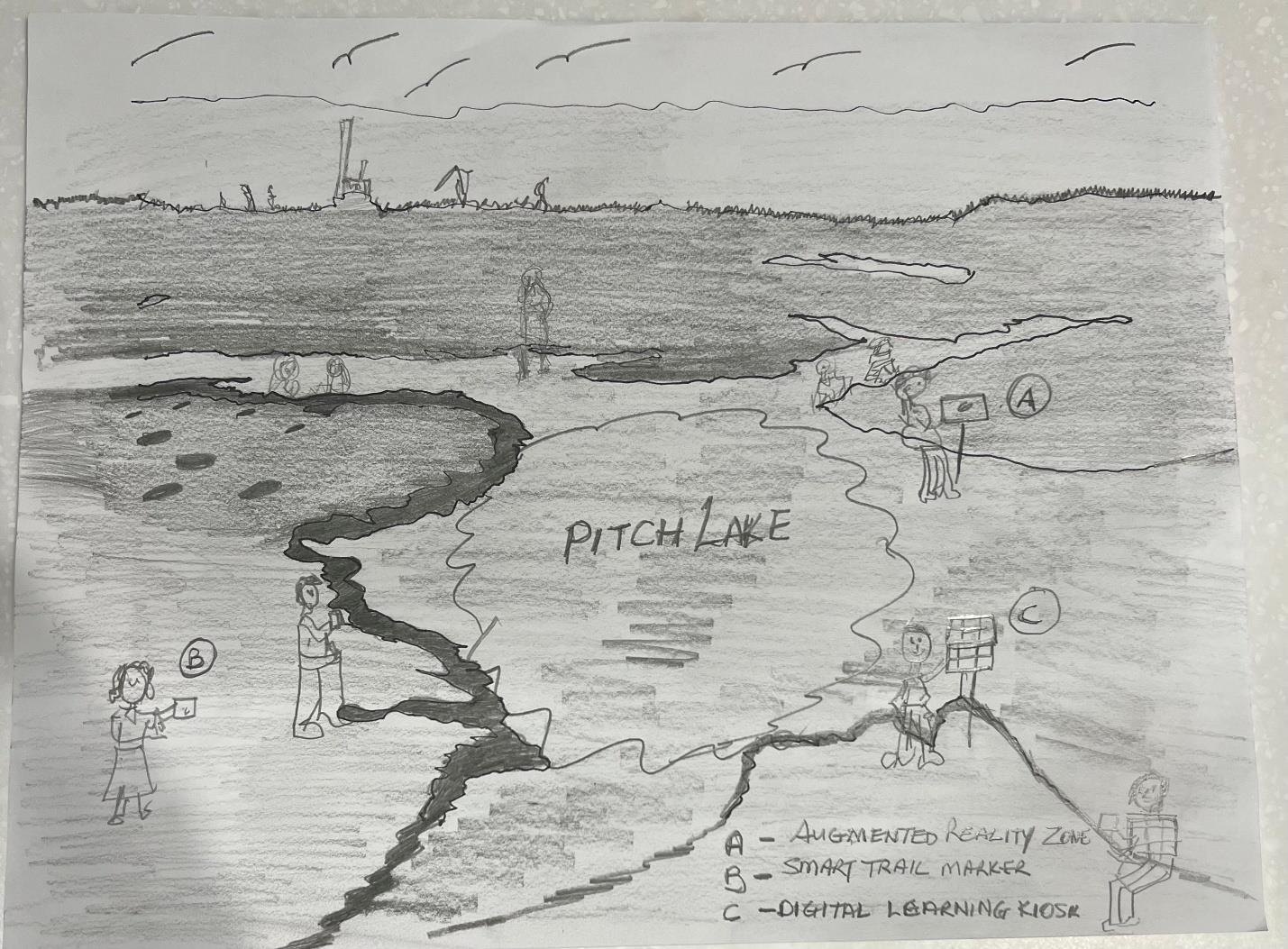
Description of Emergent Themes
EDTC 803 · Data Analysis & Report Writing · Dr. Dana Mason · August 2025
The How I Work series on Lifehacker features people from a variety of professions and provides insight into how they plan their work, manage their time, and remain productive. Even though they work in a variety of jobs and sectors, these interviews highlight recurrent themes that show how successful professionals deal with the hectic and complex work settings of today. Beyond personality or sector variations, there is a common emphasis on resilience, attention, and prioritisation. Setting clear limits, creating procedures that minimise distractions, and identifying tools or techniques that genuinely enhance their approach are all stressed by several interviewees.
Theme 1 — Personalised productivity systems
A major theme is the shift towards personalized productivity strategies. Instead of using generic tools, individuals create their own systems with platforms like Trello, Notion, or even traditional paper notebooks. These methods reflect a sense of independence and help people tailor their tasks to their personal goals, aligning with theories that emphasize the importance of having control and making choices to stay motivated and perform well through self-determination (Ryan & Deci, 2000).
Theme 2 — Routine, structure and deep work
It is crucial to have a regular schedule and organization. Many people rely on regular routines, such as morning rituals or specific times for concentrated work, to help them stay focused and avoid feeling overloaded with options. This is consistent with Newport’s (2016) idea of deep work, which emphasizes the value of uninterrupted, concentrated attention in generating excellent work. Blocks of time set out for work without interruptions enable people to perform cognitively taxing jobs more successfully, and regular routines, such as beginning each day with planning or introspection, preserve focus and lessen decision fatigue.
Theme 3 — Deliberate use of technology
Another important pattern is the deliberate use of technology. Even though digital tools are everywhere, many people choose to turn off notifications or disconnect often to avoid burnout and information overload, following the principles of digital minimalism (Newport, 2019). Additionally, setting clear priorities and boundaries helps individuals stay focused on their main objectives by eliminating low-value tasks or distractions.
Theme 4 — Blended identities and continuous learning
Many profiles highlight the importance of balancing work and personal life, as well as the value of continuous learning. Instead of keeping these areas completely separate, people often blend their professional and personal routines in ways that support mental health and long-term sustainability. They tend to see themselves as lifelong learners, demonstrating an adaptable mindset that is essential in constantly changing work environments (Senge, 1990).
Illustrative cases from the interview set
Richard Garriott’s interview centers on the deliberate use of technology to maintain presence and connection with his team despite geographical distance, relying on a telepresence robot to work between New York and Austin as though he were physically present. Jad Abumrad’s work traces a transition from individual creative autonomy to collaborative leadership, layering several voices in a manner evocative of musical counterpoint. Sirita Wright uses media entrepreneurship to advance empowerment and inclusivity, amplifying the voices of women of color through her platform EstroHaze. Will Shortz balances creative puzzle construction with traditional, book-based research over cursory internet searches.
Toomas Hendrik Ilves’s approach sits at the intersection of digital innovation and democratic governance, having driven Estonia’s digital transition through the e-Estonia programme. Demi Adejuyigbe’s process balances painstaking craftsmanship with artistic freedom, while Anil Dash builds systems that are accessible, community-focused, and participatory. Sarah Pinsker fuses creative resilience with community involvement, Janet Varney nurtures a creative community through teamwork, Phoebe Judge combines empathetic storytelling with thorough journalistic practice, and Benjamin Ho examines the role of trust in economic and social interactions.
Synthesis
The themes of intentional organization, strategic use of tools, blended identities, creative pressure, and curated input show how media professionals maintain productivity and stay relevant in a rapidly changing digital landscape. These interviews not only share individual strategies but also reflect broader cultural shifts in how work, identity, and technology come together in modern media careers. The results emphasize the importance of exploring how media workers manage the balance between visibility and sustainability, as well as autonomy and external expectations.
References
Douglas, N. (2025, June 9). The best “how I work” interviews of 2019. Lifehacker.
Newport, C. (2016). Deep work: Rules for focused success in a distracted world. Grand Central Publishing.
Newport, C. (2019). Digital minimalism: Choosing a focused life in a noisy world. Portfolio.
Ryan, R. M., & Deci, E. L. (2000). Self-determination theory and the facilitation of intrinsic motivation, social development, and well-being. American Psychologist, 55(1), 68–78.
Senge, P. M. (1990). The fifth discipline: The art and practice of the learning organization. Doubleday.
Approval of the Professional Development Stipend Based on Teaching Evaluation Results
EDTC 803 · Data Analysis & Report Writing · Dr. Dana Mason · August 2025
Method
The evaluation consisted of ten items, each rated by students on a five-point scale, with 59 responses recorded for every item. For each item a weighted mean was calculated by multiplying each rating value by the number of students who selected it, summing those products, and dividing by the 59 total responses. Item 1, for example, received two ratings of 1, five ratings of 2, ten ratings of 3, twenty-three ratings of 4, and nineteen ratings of 5, producing 229 rating points and a mean of 3.88. Each item mean was then compared with the corresponding department group mean for the same term.
Findings
| Item | Lecturer mean | Department group mean | Above group? |
|---|---|---|---|
| 1 | 3.88 | 3.70 | Yes |
| 2 | 4.22 | 4.13 | Yes |
| 3 | 3.75 | 3.85 | No |
| 4 | 3.97 | 4.03 | No |
| 5 | 4.05 | 4.02 | Yes |
| 6 | 3.24 | 2.81 | Yes |
| 7 | 4.02 | 3.92 | Yes |
| 8 | 3.69 | 3.59 | Yes |
| 9 | 3.88 | 4.32 | No |
| 10 | 3.78 | 3.52 | Yes |
| Overall | 3.85 | 3.79 | Yes |
Scores exceeded the department group mean on seven of the ten evaluation items, and the overall mean of 3.85 was higher than the department group mean of 3.79. The strongest relative results appeared on Item 6, at 0.43 points above the group mean, Item 10 at 0.26 points above, and Item 1 at 0.18 points above. These margins indicate consistent strength across the majority of the areas measured.
Three items fell below the department group mean. Item 9 shows the largest shortfall at 0.44 points below, making it the clearest area for improvement; Item 3 fell 0.10 points below and Item 4 fell 0.06 points below. Item 6 also produced the lowest absolute score at 3.24 even though it sat well above the group mean of 2.81, which suggests the item was rated low across the department as a whole.
Conclusion
Because the overall mean exceeded the department group mean and the majority of individual items were above the group mean, the lecturer meets the stated standard for automatic approval of the professional development stipend. The committee therefore approved the stipend for the evaluated term.
Recommendation
Approval of the stipend is not the end of the process. The stipend is awarded so that it can be applied toward professional development training, and the recipient must act to claim and use it. The report recommends enrolling in the department’s professional development programme for the upcoming term and applying the stipend to that enrolment; prioritising modules that address the competencies measured by Item 9, where the widest gap appears; selecting a secondary module covering Items 3 and 4; and continuing the instructional practices that produced the strong results on Items 1, 6 and 10.
K–12 Enrollment Trends: 1985, 1995, and 2005
EDTC 803 · Data Analysis & Report Writing · Dr. Dana Mason · August 2025
Purpose
This memorandum provides an overview of trends in United States K–12 enrolment across a 20-year period, from fall 1985 through fall 2005, using data from the National Center for Education Statistics. It examines shifts in both public and private school attendance, identifies the patterns visible in those shifts, and offers recommendations to help with future planning.
Overview and Insights
Total K–12 enrolment grew substantially over the two decades examined. Public school enrolment rose from 39,422 thousand students in fall 1985 to 45,037 thousand in fall 1995 and 49,113 thousand in fall 2005, a net gain of 9,691 thousand students, or approximately 24.6 percent. Private school enrolment grew far more modestly over the same period, from 5,557 thousand to 5,672 thousand and then to 6,073 thousand, a net gain of 516 thousand students, or approximately 9.3 percent. Combined enrolment across both sectors increased from 44,979 thousand to 55,186 thousand, a gain of 10,207 thousand students.
Three patterns emerge. First, public schools absorbed nearly all of the growth: of the 10,207 thousand additional students enrolled between 1985 and 2005, roughly 94.9 percent entered public schools, which means the entire increase in demand for classrooms, teachers and facilities fell on publicly funded systems. Second, the pace of that growth was uneven. Public enrolment climbed by 5,615 thousand students between 1985 and 1995 but by 4,076 thousand between 1995 and 2005, so the steepest expansion occurred in the first ten years and then moderated; planning based on the earlier rate alone would have overstated later demand. Third, the private sector’s share of total enrolment contracted slightly, from 12.4 percent in 1985 to 11.2 percent in 1995 and 11.0 percent in 2005 — not a decline in absolute terms, but slower growth than the public sector.
The upward trend signals not only a demand for more educational infrastructure, but also a need to evaluate how effectively current systems serve diverse and changing populations. Without proactive planning and investment, the system risks being overextended, potentially leading to overcrowded classrooms, staffing shortages, and unequal learning conditions.
Recommendations
To keep pace with rising enrolment it is important to expand school facilities and hire more staff, directing effort toward constructing new schools, improving existing buildings, and bringing in more qualified teachers and support staff. Examining regional trends at the state and district levels can help identify areas experiencing the fastest growth and ensure resources are distributed more fairly.
It is also vital to understand how differences in local and state funding impact student outcomes, as disparities can limit access to advanced classes and support services. Federal data support this concern directly: national findings from the Civil Rights Data Collection show that high schools serving the highest proportions of Black and Latino students offer advanced mathematics and science courses at measurably lower rates than high schools nationally (U.S. Department of Education, Office for Civil Rights, 2018).
Above all, equity should remain a central focus, and the enrolment data explain why. Because public schools absorbed approximately 95 percent of the net growth, the burden of accommodating additional students fell almost entirely on the systems most dependent on public funding formulas. When enrolment rises faster than funding, that strain concentrates in communities with the weakest local tax bases — frequently the same communities least able to add classrooms, recruit certified teachers, or sustain advanced course offerings. The national totals therefore conceal an important distributional question: a net increase of 9,691 thousand public school students is manageable if capacity expands where those students actually live, and damaging if it does not.
Policy responses should accordingly be evaluated not only by whether total capacity keeps pace with total enrolment, but by whether capacity grows in the specific communities absorbing the largest increases. Enrolment projections disaggregated by state and district, paired with measures of funding adequacy, would allow planners to identify those communities in advance rather than after classrooms are already overcrowded.
References
National Center for Education Statistics. (1995). Mini-digest of education statistics 1995: Enrollment. U.S. Department of Education.
National Center for Education Statistics. (2007). Table 1. Public school student membership, by grade and state or jurisdiction: School year 2005–06 (NCES 2007-352). U.S. Department of Education.
National Center for Education Statistics. (2017). Table 205.80. Private elementary and secondary schools, enrollment, teachers, and high school graduates, by state: Selected years, 2005 through 2015. In Digest of education statistics 2016. U.S. Department of Education.
U.S. Department of Education, Office for Civil Rights. (2018). 2015–16 civil rights data collection: STEM course taking.
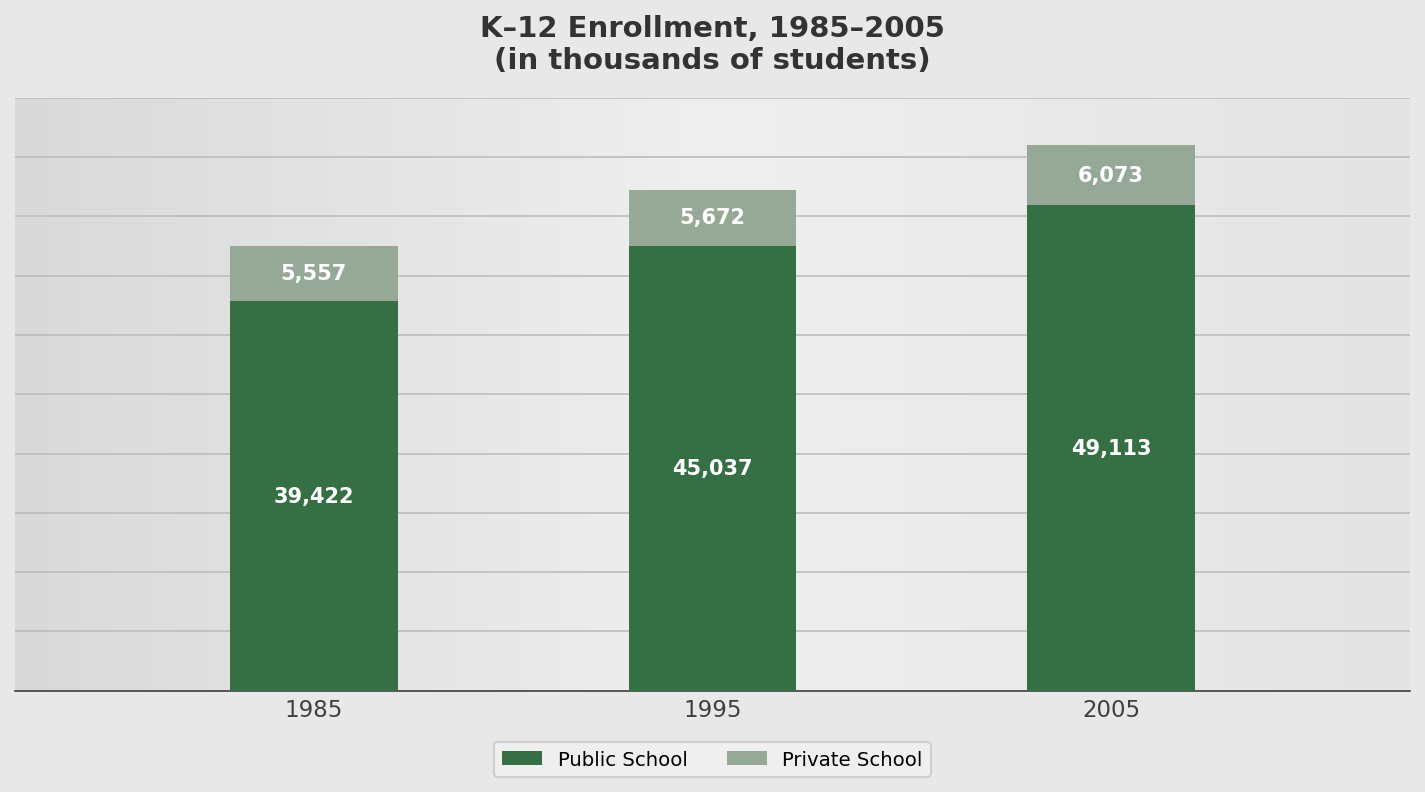
Simulation-Based Training and Virtual Reality in Emergency Room Education
EDTC 806 · Research Methods in Educational Technology · Dr. Christopher Shamburg · February 2026
Overview
Virtual reality and simulation-based training are becoming increasingly prevalent in emergency room teaching, and they are changing the field. These developments address part of the difficulty of preparing medical practitioners for high-stress, high-stakes situations where prompt decision-making and sophisticated clinical abilities are essential. As healthcare systems become more complex, traditional approaches such as classroom education and clinical rotations are no longer adequate on their own to prepare emergency department workers for the range and severity of events they may encounter.
This review evaluates the advantages, disadvantages, and potential applications of virtual reality and simulation-based technologies in emergency department education, and examines the impact of these immersive tools on clinical decision-making, teamwork, skill retention, and learner confidence in high-stress medical settings.
Simulation-based training: traditional and emerging approaches
Simulation has long been a vital tool in medical education because it gives students the chance to practice technical skills and decision-making in a safe, regulated setting. Conventional approaches, such as high-fidelity mannequins used for CPR or intubation, provide a platform for training fundamental clinical skills but have limitations when it comes to replicating complex or uncommon scenarios. Virtual reality has greatly improved simulation training by producing more adaptable, dynamic, and immersive experiences that more accurately capture the uncertainty and stress of actual emergency room situations.
Through immersive environments, learners experience the psychological intensity and decision-making demands typical of emergency room practice in addition to the procedural aspects of emergency care (Fanning & Gaba, 2007). A further benefit is the ability to rehearse unusual or dangerous situations deliberately and repeatedly in a controlled environment, unconstrained by clinical availability or patient safety concerns (Kneebone, 2003).
Key technologies
Virtual reality. Fully immersive 360-degree environments let learners interact with trauma circumstances and multi-casualty incidents, practicing crisis management in real time and carrying out crucial tasks under duress. The immersive quality of the training improves communication, critical thinking, and problem-solving (Sutherland et al., 2015).
Augmented reality. Rather than replacing the environment, augmented reality superimposes virtual information on real-world situations, walking learners through procedures in real time. It can offer detailed visual guidance for difficult procedures such as wound suturing, chest tube placement, and intubation, closing the gap between virtual simulation and practical use.
AI-driven feedback. AI-powered systems provide data-driven, real-time feedback on learner performance, evaluating both procedural correctness and decision-making speed. These systems can adjust scenario difficulty according to the learner's progress, producing individualized training that continues to challenge students as they develop (Stewart et al., 2019; Sriram et al., 2025).
Combined, these technologies support team-based simulations that help physicians, nurses, and paramedics cooperate more effectively under pressure — important because emergency room teams routinely operate in high-stress settings where cooperation is essential (Weller et al., 2012).
Challenges and limitations
Cost. High-quality systems require significant investment in hardware, software development, technical support, and ongoing maintenance, which can restrict accessibility in smaller institutions and resource-limited settings (Gaba, 2004; Abbas et al., 2023). Scalability remains an issue where universities lack sufficient infrastructure, despite evidence of the educational benefits of immersive platforms (Walls et al., 2024).
Fidelity. Immersive simulations may not accurately capture the psychological intensity, unpredictability, and emotional strain of actual emergencies, which may affect stress exposure and the transfer of performance to real clinical settings (Berkman et al., 2017). Transfer of simulated competence to high-stakes situations remains an area needing further research, even as studies show gains in engagement, confidence, and skill acquisition (Brown et al., 2023; Castillo-Rodríguez et al., 2025).
Integration. The learning curve for sophisticated simulation systems can initially reduce training effectiveness. Effective adoption requires curriculum change, technical training, and faculty development so that these tools are pedagogically aligned rather than treated as standalone technology additions; research on VR-based emergency rescue education indicates that structured, instructor-led implementation enhances learner satisfaction and perceived effectiveness (Li et al., 2025).
Synthesis
Incorporating virtual reality, augmented reality, and artificial intelligence into emergency medical education improves clinical decision-making, technical proficiency, and cooperation under pressure. Simulation-based training has been shown to increase response times and accuracy in emergency scenarios, with virtual reality simulations outperforming traditional teaching methods (Fanning & Gaba, 2007).
By participating in VR-based triage activities, learners improve their clinical reasoning, practice establishing treatment protocols, and develop confidence in managing trauma cases. Scenario-based simulations mimic stressful emergency situations, allow real-time decision-making, offer instant performance feedback, and promote collaborative teamwork without endangering patient safety. AI-powered feedback systems extend this by providing tailored guidance that adapts to each learner's progress, assessing both technical proficiency and the quality of decisions made under pressure (Stewart et al., 2019). Team-based simulations give personnel from various specialties the opportunity to practice responding to emergencies together, improving the coordination and communication essential to effective work in an emergency room (Weller et al., 2012).
Conclusion
The incorporation of simulation, virtual reality, augmented reality, and artificial intelligence has brought about a significant change in how healthcare personnel are prepared for the complexity of real-world emergencies. These technologies foster critical thinking, decision-making, and teamwork alongside technical proficiency, and allow students to train on uncommon and intricate medical situations without endangering patients (Fanning & Gaba, 2007; Sutherland et al., 2015).
Their full promise cannot be achieved without resolving the outstanding issues. Cost remains a major deterrent to broad adoption, particularly for low-resource environments and smaller facilities, and technological fidelity still falls short of the confusion and emotional strain of actual emergencies. Refining these technologies can make training experiences more realistic and engaging, bridging theoretical knowledge and practical application (Berkman et al., 2017). Even so, simulation should supplement conventional clinical practice rather than replace it: under the guidance of seasoned clinicians, practical patient encounters remain essential to refining skills and developing clinical judgment. A hybrid model is therefore the most sustainable approach to emergency room education.
The Impact of Digital Learning Platforms on Student Engagement and Academic Performance in Higher Education
EDTC 806 · Research Methods in Educational Technology · Dr. Christopher Shamburg
Purpose
This quantitative study examines whether undergraduate students who use digital learning platforms more frequently earn higher grades, and whether student engagement accounts for that relationship. Three variables are measured: platform use, defined as activity recorded in the learning management system; student engagement, defined as behavioral, emotional, and cognitive involvement in coursework; and academic performance, defined as final course grade. The study also asks whether digital literacy changes the strength of the link between platform use and engagement.
Recent research frames the problem. A systematic review of learning analytics reports that involvement in the learning management system — activity in learning tasks, click frequency, connection time — is a promising predictor of academic success (Hernández-Campos et al., 2025). A systematic review of fully online higher education, however, found achievement most strongly associated with motivation and self-regulation rather than platform activity alone (Chung et al., 2022). That tension is the gap this study addresses: platform use appears to matter, but probably through the engagement it produces rather than on its own.
Research questions
1. To what extent is frequency of platform use associated with student engagement? 2. To what extent is engagement associated with final course grade? 3. Does engagement mediate the relationship between platform use and academic performance? 4. Does digital literacy moderate the relationship between platform use and engagement?
Significance
As institutions continue to invest in educational technology, determining whether that investment produces measurable gains in engagement and achievement is essential to justifying continued spending and to designing courses well. McKenna et al. (2024) quantified online engagement across three undergraduate year levels using learning management system data mining; Teng and Wang (2021) found educational technology tools significantly affected the behavioral, emotional, and cognitive dimensions of engagement; and Du Plooy et al. (2024) documented effects of personalized adaptive learning on both performance and engagement. What remains unresolved is that these variables are typically studied in pairs rather than within a single model, and the conditions under which platform use converts into engagement are not well specified.
Design
The study uses a quantitative correlational design with mediation and moderation analysis. The independent variable is platform use, operationalized as a composite of learning management system activity across one semester: total logins, total time on task, and number of course items accessed. The mediating variable is student engagement. The dependent variable is academic performance, operationalized as the final percentage grade obtained from institutional records rather than self-report. The moderating variable is digital literacy.
Pearson correlation establishes the bivariate relationships; multiple regression tests whether platform use predicts final grade once engagement is entered; the PROCESS macro tests engagement as a mediator and digital literacy as a moderator of the platform-use-to-engagement path. Participants will be 150 to 300 undergraduates enrolled in courses that use a learning management system as a required component.
Instruments
Data come from two sources rather than four, keeping the design manageable within a single semester and avoiding redundant measures of the same construct. The first is a single online questionnaire containing two established subscales — an engagement measure covering the dimensions described by Fredricks et al. (2004), and a digital literacy measure based on Ng (2012) as applied in recent higher education research (Zakir et al., 2025). The second is institutional learning management system records, which supply both the platform-use composite and the final course grade, following the approach taken by McKenna et al. (2024).
Limitations and delimitations
Engagement and digital literacy are self-reported, which introduces response bias; using institutional records for platform use and grades reduces but does not eliminate this. The single-institution undergraduate focus limits generalizability, and the correlational design cannot establish causation. External variables including motivation, self-regulation, course design, and instructor effectiveness are not controlled — a substantive limitation, since Chung et al. (2022) found motivation and self-regulation to be the strongest correlates of achievement in online higher education. Platform activity counts also measure quantity rather than quality of interaction, which recent analytics research cautions is the weaker predictor (Hernández-Campos et al., 2025).
By design the study is restricted to undergraduates in courses using digital platforms, concentrates on four variables, and excludes qualitative data — meaning it can establish whether relationships exist but not why students engage as they do.
Navigating Triage: A Qualitative Study of Patient Experiences in Emergency Room Intake
EDTC 806 · Research Methods in Educational Technology · Dr. Christopher Shamburg
Statement of the problem
Emergency room triage establishes the order in which patients receive care according to the severity of their conditions (Gilboy et al., 2011). Despite its importance, patients frequently report confusion, anxiety, and dissatisfaction during the process. An integrative review of patient experience at emergency department triage found that waiting, information, initiation of care, and interactions with staff most shaped how patients experienced this stage, and concluded that current processes may not adequately account for individual needs (Janerka et al., 2024).
Triage research has concentrated on efficiency and clinical accuracy rather than on how patients understand what is happening to them. Crowding has well-documented effects on care delivery (Hoot & Aronsky, 2008) and is associated with lower patient satisfaction (Pines et al., 2008), but those quantitative findings cannot show how patients themselves interpret the delays and priority decisions they encounter.
Purpose and research questions
The study describes the lived experiences of adult patients during triage at a single urban emergency department: how they perceive triage processes, how they interpret interactions with triage nurses, and how they experience the psychological effects of waiting and prioritization. It follows Wolf et al. (2021) in treating patient experience as a human and relational matter rather than service satisfaction alone.
Four questions guide the work: how patients describe their experiences throughout triage; how they perceive communication with nurses and staff; what emotions they report while being triaged and waiting; and which aspects of the process affect their comprehension of, and satisfaction with, their care.
Design
The study uses a descriptive phenomenological design, appropriate because the research question concerns the meaning participants attach to an experience rather than its frequency or measurable outcome (Creswell & Poth, 2018). Purposive sampling with maximum variation ensures diversity in age, gender, presenting condition, and assigned acuity level.
An initial sample of 12 to 15 participants is planned, with sample size guided by information power rather than a fixed target — a narrowly defined aim, a specific sample, and strong interview dialogue all reduce the number required (Malterud et al., 2016). Recruitment halts when two consecutive interviews generate no new codes.
Data collection and analysis
Semi-structured one-to-one interviews of 45 to 60 minutes will be conducted within two weeks of the participant's visit, a window chosen to balance recall accuracy against the impracticality of interviewing patients still in acute distress. Interviews are audio recorded with consent, transcribed verbatim, and de-identified; the study will be submitted for institutional review board approval before recruitment begins.
Transcripts will be analyzed using reflexive thematic analysis following the six phases described by Braun and Clarke (2006), with inductive coding derived from the transcripts rather than applied from an existing framework. Trustworthiness is supported through member checking, peer debriefing, an audit trail documenting coding decisions, and a reflexivity journal recording the researcher's own assumptions as a practitioner in emergency care.
Limitations and delimitations
The sample is small and non-random, so the aim is transferability of insight rather than statistical generalizability. Accounts may be affected by recall bias, and single-site recruitment limits reflection of variation across hospitals and healthcare systems. Patients with exceptionally positive or negative experiences may be more inclined to volunteer, producing response bias. Because the study is qualitative, conclusions are interpretive and depend in part on the researcher's analytic judgment — which the reflexivity journal, audit trail, member checking, and peer debriefing are designed to make visible and accountable.
By design the study includes only adults triaged at one urban emergency room within the previous three months who are medically stable and able to interview in English, and it examines only the triage portion of the visit rather than the diagnostic, treatment, or discharge processes that follow.
The Impact of Wearable Technology on Patient Monitoring and Clinical Decision-Making in Emergency Rooms
EDTC 806 · Research Methods in Educational Technology · Dr. Christopher Shamburg
Introduction
Emergency rooms function in high-pressure settings that require rapid assessment, ongoing monitoring, and prompt intervention. Wearable technologies — biosensors, smart monitors, wireless physiological trackers — have emerged as instruments that could enhance emergency care by enabling continuous real-time monitoring and improving communication between providers.
The evidence base is developing but uneven. A systematic review and meta-analysis of randomized controlled trials on continuous vital sign monitoring in general wards found the technology feasible at scale while noting that effects on hard clinical outcomes remain limited and variable (Bowles et al., 2024). A narrative review of postoperative ward monitoring reached a similar conclusion, identifying promise in earlier detection of deterioration alongside unresolved questions about alarm burden and workflow integration (Khanna et al., 2025). Emergency medicine specifically has less evidence than ward-based care.
Statement of the problem
Emergency rooms often experience delays in monitoring because of overcrowding, staffing shortages, and reliance on intermittent manual vital sign checks — conditions that raise the risk of missed decline and delayed intervention. Wearables offer continuous surveillance, yet their value in this setting is not well established (Alotaibi et al., 2026). A second problem concerns the people using the devices: implementation research has repeatedly identified alarm burden, device reliability, and workflow integration as the barriers that determine whether a technology succeeds in practice (Khanna et al., 2025).
Design
The study uses a convergent parallel mixed methods design, in which both strands are collected during the same period, analyzed separately, and merged at interpretation (Creswell & Plano Clark, 2018). The design is appropriate because the question requires two kinds of evidence neither strand supplies alone: measurable change in patient outcomes, and clinician accounts of why the technology did or did not work.
Quantitative strand. A quasi-experimental pre-test and post-test comparison of patient outcomes before and after wearable implementation, drawing records for roughly 200 patients per period from existing hospital data systems. Outcomes include time from first recorded deterioration to clinical response, monitoring frequency, length of stay, adverse event rate, admission rate, and 30-day readmission. Analysis uses descriptive statistics, paired-sample t tests, ANOVA across sites, and regression adjusting for patient acuity and department census.
Qualitative strand. A phenomenological examination of clinicians' lived experience, using semi-structured interviews of 45 to 60 minutes supplemented by structured observation notes. Limiting collection to two sources rather than adding focus groups keeps the design feasible within the time constraints of emergency practice. An initial sample of 15 to 18 clinicians is planned, with recruitment continuing until successive interviews produce no new codes. Analysis follows the six phases of reflexive thematic analysis described by Braun and Clarke (2006).
Integration
The strands merge through a joint display, a table arraying quantitative results alongside the qualitative themes bearing on the same question so convergence and divergence become visible (Creswell & Plano Clark, 2018). A measured reduction in response time would sit beside clinician accounts of how alerts changed monitoring behavior; an absence of measured change would sit beside accounts of alarm fatigue or workflow obstacles. Points of divergence are treated as findings rather than problems — where outcome data and clinician experience disagree, the discrepancy itself indicates something about implementation.
Limitations
Sample size and number of participating hospitals limit scope, and results may not transfer to non-emergency settings. The quasi-experimental design carries a specific threat: because the two periods are separated in time, unrelated changes in staffing, volume, or protocol could account for differences attributed to the technology. Given that existing evidence on continuous monitoring shows mixed results on hard outcomes (Bowles et al., 2024), the study may find change in process variables such as monitoring frequency without corresponding change in admission or adverse event rates — a pattern that should be anticipated rather than treated as a failure of the design.
EDTC 811 (Summer Institute III), EDTC 901 & 902 (Dissertation I–II): no assessments required for the QE.